


Intro
Do want to learn your first Portuguese words and phrases in a matter of minutes?
Or maybe… You already speak a little Portuguese, and want to refresh your memory and learn new things?
In both cases, you are at the right place! Here you will find Portuguese material for English-speaking beginners. With these resources you will communicate much better in this beautiful language.
You do not need to have previous knowledge of Portuguese to follow this language guide for beginners.
- But you will enjoy it more if you know at least the pronunciation of Brazilian Portuguese. Here you will find a very practical guide, where I teach you how to pronounce any word as a true Brazilian would.
In the videos I say the phrases first in Portuguese and then in English.
- You have subtitles if you want. You have the transcript in this post, too.
In these videos you will learn very useful, essential Portuguese phrases, and you will see that you can use them straight away to communicate in real life, in your daily life and while traveling.
If you want to watch all the videos in a row, here you have them.
In addition, you will find in this post relevant comments on aspects of the Portuguese grammar that appear in the videos. I indicate this with the symbol.
You will also find interactive flashcards to practice what you learned in the videos. You can choose your favorite gaming or learning mode. And you have quizzes to practice the information.
And if you want to learn Brazilian Portuguese systematically and from the very beginning, you have a FREE ONLINE mini-course with explanations in English in which you will learn the basis of communication. Check it out here:
How to Speak Portuguese: Guide for English-Speaking Beginners
If you are curious to know where I have recorded the videos, they are all made in Palma de Mallorca. If you’ve ever been to the Mediterranean island, you will recognize some of the locations.
What you will learn in this series of short Portuguese videos
In this guide, I will teach you in a summarized and useful way important features of the Portuguese language for English speakers. The aspects of the grammar that you will learn are the following:
- The omission of the subject pronoun in the comment of video #2.
- The verbs and prepositions to indicate the place in Portuguese in the comment of video #4.
- The adjectives in Portuguese in the commentary of video #6.
- The verb “GOSTAR” in Portuguese in the commentary of video #7.
- The use of “MUITO” in the comment of video #10.
- The difference between the verbs “SER” and “ESTAR” in the comment of video #11.
- The adjectives “BOM” and “MAU” in the comment of video #11.
- The verbs “IR”, “VIR”, “LEVAR” and “TRAZER” in the comment of video #12.
- The simple negative and the double negative in the comment of video #12.
- The most important expressions with the verb “TER” and “ESTAR” in Portuguese in the commentary of video #13.
- The structures “TER + QUE” + infinitive and “PODER” + infinitive in the comment of video #13.
- The future with “IR” + infinitive (“VOU COMER”) in Portuguese in the commentary of video #16.
- The verb “PEDIR” in Portuguese in the commentary of video #16.
Click on the index to go to the video that interests you the most.
Video 1. How to greet and how to say goodbye in Portuguese
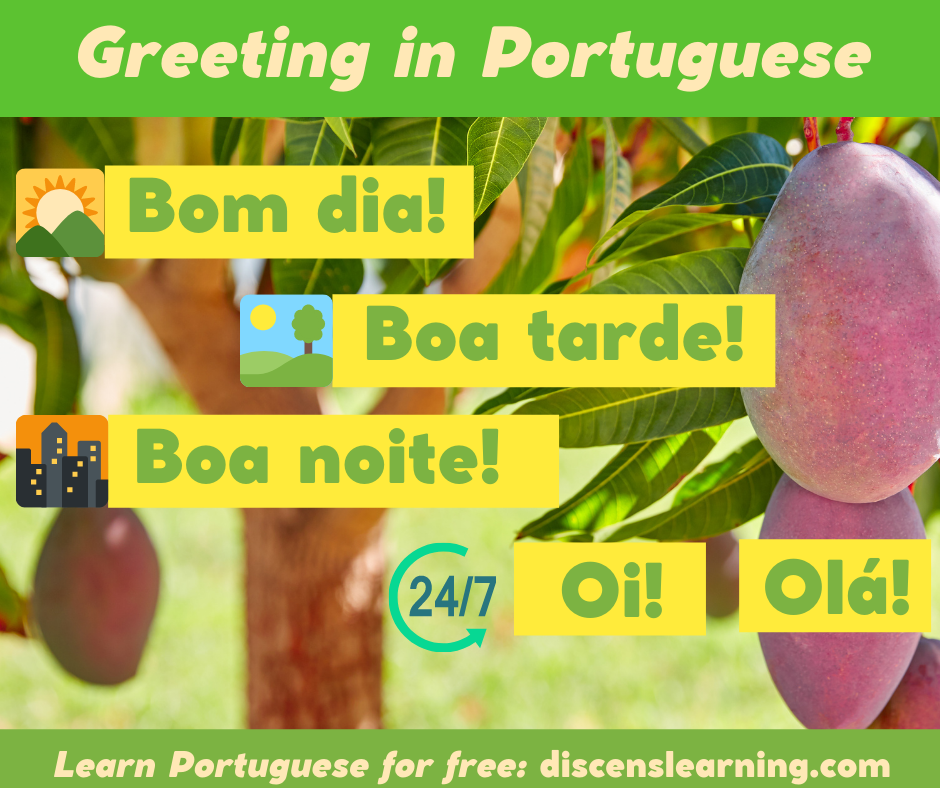
In this video you will learn the most frequent greetings and farewell expressions in Portuguese.
| Oi. | Hello. |
| Bom dia. | Good morning. Good day. |
| Boa tarde. | Good afternoon. |
| Boa noite. | Good evening. Good night. |
| Até logo. | See you later. |
| Até mais. | See you soon. |
| Até à vista. | Goodbye. |
| Até amanhã. | See you tomorrow. |
| Até a próxima. | See you next time. |
| Tchau. | Bye. |
| Adeus. | Goodbye. |
🕵️♀️Why do we say “BOM DIA” and not *”BOA DIA” in Portuguese?
😘”BOM DIA” is the right formula to wish someone a good morning/day. Saying *”BOA DIA” is incorrect.
❗We must say “BOM DIA” because “O DIA” is masculine and singular. “BOM” is the adjective that accompanies “DIA” and, therefore, must have the corresponding ending (masculine, singular).
- You will learn a little more about adjectives in the comments on videos #6 and #22 in this series.
✨You have a very practical guide on greetings, farewells, and polite formulas in Portuguese with video and material to download for free.
🤷♂️How do I know if a noun is masculine or feminine in Portuguese? How do I know which is correct, “O DIA” or *”A DIA”?
🥴Many foreigners get confused when told that “O DIA” is a masculine noun because they assume that all Portuguese nouns ending in -A are feminine.
🙃This reasoning is logical, but languages are not always logical…
💡Most nouns ending in -A in Portuguese are feminine, that is right. But “O DIA” is an exception: it ends in -A, but it is masculine.
⚠Some nouns ending in -MA, -PA, and -TA are also masculine in Portuguese, such as “O PROBLEMA” or “O IDIOMA” (“problem”, “foreign language”). Some, but not all.
- You will learn these nouns in the commentary of video #20 of this series.
👉I teach you the most general rules about the gender of nouns in Portuguese:
✅Most nouns ending in -A are feminine in Portuguese. Exception “O DIA” and some nouns with the endings “-MA”, “-PA”, “-TA”.
✅Nouns ending in -ADE, -GEM and -UME are feminine in Portuguese. There are no exceptions.
✅Nouns ending in -L are feminine in Portuguese. Exceptions: “A CAPITAL”, “A CATEDRAL” (“capital city”, “cathedral”).
✅All nouns ending in -Á (with accent!) -O and -OR in Portuguese are masculine in Portuguese. Exceptions: “A FLOR”, “A COR”, “A DOR” (“flower”, “color”, “pain”).
In the table you will see everything clearer:
| gender | ending | exception |
| feminine | -A | 🌞O DIA |
| feminine | -ADE, -GEM, -UME | ❌ |
| feminine | -L | 🎌A CAPITAL, 🕍A CATEDRAL |
| masculine | -O, -OR | 🌼A FLOR, 💚A COR, 🤕A DOR |
| masculine | -Á | ❌ |
✅There are long words like “A MOTOCICLETA”, “A FOTOGRAFIA” and “A RADIOFONIA” that are feminine. Therefore, when we abbreviate them, they maintain the feminine gender: “A MOTO”, “A FOTO”, “A RÁDIO” (“motorcycle”, “photo”, “radio broadcaster”). It is logical, right?
✅Most of the Portuguese words that come from English have the masculine gender, such as “O FUTEBOL” (“soccer”). But we say “A INTERNET”.
👉There are endings that are not characteristic of one gender or the other. This is the case of -E, -ÃO, -Z. If a noun has these endings, it is convenient to learn it with the corresponding article. 😊But there are not many nouns in that category.
🎬In this short video (in Portuguese, with captions in Portuguese/English) you will learn nouns in Portuguese that end in -A, but are masculine. ⭐You can change the playback speed if you prefer a slower video.
👩🏫This has been a (brief) introduction to the gender of nouns in Portuguese. You will easily learn everything you need to know about Portuguese nouns, with very relevant vocabulary, in lesson #6 of the Portuguese course with webinars (level A1).
- If you meet a friend to do something together in the evening.
- If you say goodbye to that friend when the evening out is over.
- If you are going to bed and want the other person to have a good night’s sleep.
- However, it is also used for a final goodbye. That’s why, depending on the context, “ADEUS” may sound a bit dramatic.
Do you want to learn 83+ ways to say hello, to say goodbye, and to ask and to answer “how are you?” in Brazilian Portuguese? You have a free guide with video and PDF material to download here.
Downloadable PDF + MP3 | 89+ Portuguese Conversation Starters
Video 2. How to solve communication difficulties in Portuguese
Learning a language is also knowing how to solve problems that may arise with the communication. With the phrases that you will learn in this video, you will be able to deal with any misunderstanding – even if you speak very little Portuguese.
| Não entendo. | I don’t understand. |
| Mais devagar, por favor. | Slowly please. |
| Não sei. | I don’t know. |
| O que significa? | What does it mean? |
| Pode repetir, por favor? | Can you please repeat? |
| O que é isto? | What is this? |
| Por exemplo. | For example. |
If you do not understand, you can say in Portuguese “NÃO ENTENDO” or, what is the same, “NÃO COMPREENDO”.
| NÃO ENTENDO. | I do not understand. |
| NÃO COMPREENDO. | I do not understand. |
To ask the person to speak more slowly, you can say in Portuguese “MAIS DEVAGAR, POR FAVOR” or also “MAIS LENTAMENTE, POR FAVOR”.
| MAIS DEVAGAR, POR FAVOR. | Slowly, please. |
| MAIS LENTAMENTE, POR FAVOR. | Slowly, please. |
Here a couple of songs about taking it easy (“DEVAGARINHO”, which means “really slow”), the Brazilian way:
To indicate that you do not know, you will say in Portuguese “NÃO SEI”.
Realize that in Portuguese simple negative is very easy: just place “NÃO” in front of the verb. That is why we say:
| (EU) ENTENDO. | I understand. |
| (EU) NÃO ENTENDO. | I do not understand. |
| (EU) SEI. | I know. |
| (EU) NÃO SEI. | I do not know. |
Do you realize I add “(EU)” in parentheses? That is because personal pronouns (subject pronouns) in Portuguese – especially “EU” (“I”) and “NÓS” (“we”) are often omitted.
- These pronouns are not grammatically necessary and therefore we, native speakers, do not make them explicit when we speak.
- That phenomenon is not standardized in the English language. But in Portuguese omitting personal pronouns is very common and not necessarily colloquial.
- If you do not feel comfortable doing so, you do not need to omit subject pronouns. But do not be surprised when natives do.
If you want the person to repeat what they said, the phrase is “PODE REPETIR, POR FAVOR?”. You can add “VOCÊ” to address someone in an informal situation (in Brazilian Portuguese): “VOCÊ PODE REPETIR, POR FAVOR?”.
In Brazil, if we are in an informal context, we use “VOCÊ” as a form of address. It is the third person of the singular.
If the situation is formal, we keep the third person of the singular, but we use two forms of address, depending on the gender of the person:
- ”O SENHOR” if we address a man
- ”A SENHORA” if we address a woman
| formal | (O SENHOR) PODE REPETIR? | Can you repeat? |
| formal | (A SENHORA) PODE REPETIR? | Can you repeat? |
| informal | (VOCÊ) PODE REPETIR? | Can you repeat? |
In general, Brazilian culture is casual. We use “VOCÊ” with almost everyone (acquaintances and strangers).
Depending on the context, it may be appropriate to use “O SENHOR” / “A SENHORA” – for example, in a fancy restaurant or in certain work environments.
- If you do not know if you should address the person as “VOCÊ” or “O SENHOR”, the easiest thing is to simply skip the form of address.
- That is, you use the verb in the third person of the singular as you see it here and that’s it. Simple, right?
In this video (in which I teach you the main travel phrases in Portuguese) you will learn how to handle misunderstandings (starting on minute 17:38). You have in-depth explanations and a downloadable PDF phrasebook to speak Portuguese during a trip here.
Video 3. How to be polite in Portuguese
The first few sentences you should learn in a foreign language include expressions of courtesy. Being friendly will open many doors for you, even if you do not speak much Portuguese.
| Por favor. | Please. |
| Muito obrigado/a. | Thank you very much. |
| De nada. | You are welcome. |
| Perdão. | Pardon me. |
| Desculpe. | Pardon me. |
| Sinto muito. | I am very sorry. |
| Lamento muito. | I am very sorry. |
| Não tem problema. | It is ok. |
| Igualmente. | The same to you. |
| Com licença. | May I? |
When you ask for something (by saying “POR FAVOR”) and get it, you will show gratitude by saying “OBRIGADO/A”.
Notice that in Portuguese there are two words to say “thank you”:
- “OBRIGADO” is what you say if you are a man
- “OBRIGADA” is what you say if you are a woman
If you want to intensify, add “MUITO”: “MUITO OBRIGADO/A”.
The way to react to “OBRIGADO/A” is to say “DE NADA”.
And how do we say we are sorry in Portuguese? There are different ways to acknowledge that you did something wrong and to accept apologies. And below you have explanations in greater detail.
- In this short immersive video (with subtitles in Portuguese/English) you will learn useful phrases to ask for forgiveness. You can change the playback speed.
To apologize, you can say “PERDÃO” or “DESCULPE.” Those words also serve to get the attention of a person in Portuguese (for example, to call the waiter in the restaurant).
- In Portuguese, if you use “VOCÊ” as a form of address, the correct thing to do is to say “DESCULPE”. However, in daily communication it is very common to use “DESCULPA” as well.
- In addition to “PERDÃO,” you can say “(ME) PERDOE” (always) and “(ME) PERDOA” (colloquially, when using “VOCÊ”)
If you want to vary a little the ways to ask for forgiveness in Portuguese, here is a table with the formulas:
| neutral | PERDÃO | PEÇO DESCULPAS |
| formal | ME PERDOE / ME PERDOA | ME DESCULPE / ME DESCULPA |
| informal | ME PERDOE | ME DESCULPE |
how to ask for forgviveness in Portuguese
You can include “ME” in these formulas, but it is optional.
There are two additional ways to say “I am sorry” in Portuguese:
- “SINTO MUITO”
- “LAMENTO MUITO”
These phrases are used if you have made a mistake (just like “PERDÃO” and “DESCULPE”). But you also use them if you are not responsible for an unfortunate situation, but you want to show empathy.
If someone asks you for forgiveness, the most common reaction in Portuguese is “NÃO TEM PROBLEMA.”
There is no harm in using “POR FAVOR” and “(MUITO) OBRIGADO/A” in Portuguese. Even if you speak little Portuguese, these are short words that will make Brazilians appreciate your kindness and they will be more willing to help you.
It is really like that! For example, if you are traveling and want to buy something in a store, you can simply point to the object you want (if you do not know its name).
- To ask the price, you will use the phrase “PERDÃO, QUANTO CUSTA?” It is simple and polite.
Do you want a little more “survival Portuguese”? Here you have examples of basic and alternative phrases, so you can place your order in a café or restaurant in Brazil, using basic polite phrases:
| to call the waiter | GARCOM. / COM LICENÇA. / DESCULPE. |
| to call the waitress | GARÇONETE. / COM LICENÇA. / DESCULPE. |
| to ask for the menu | (QUERIA) O CARDÁPIO, POR FAVOR. |
| to order a beverage | PARA BEBER, (QUERIA) … |
| to order a meal | PARA COMER, (QUERIA) … . |
| to ask for the check | A CONTA, POR FAVOR. |
| to ask if you can pay by card | DESCULPE, ACEITAM CARTÃO? |
In Brazil it is customary to call the waiter saying “GARÇOM!”. It is not disrespectful, but in Portugal it should be avoided. In Portugal I advise you to say “SE FAZ FAVOR!” instead.
”(EU) QUERIA” is polite, but you do not need to use that verb if you do not want to. If you really speak almost no Portuguese, you can use the phrases as you see them in the table.
You can learn more useful phrases for shopping and eating out in the “Portuguese for travelers” video above (in this post, in the comments of video 2). You will find these phrases starting on minute 25:06.
Video 4. How to offer personal information in Portuguese
In this video you will briefly learn how to ask personal questions and how to answer them.
| Como você se chama? | What is your name? |
| Eu me chamo Alicia. | My name is Alicia. |
| De onde você é? | Where are you from? |
| Eu sou do Brasil. | I am from Brazil.. |
| Quantos anos você tem? | How old are you? |
| Tenho 33 anos. | I am 33 years old. |
| Onde você mora? | Where do you live? |
| Eu moro na Espanha. | I live in Spain. |
When someone asks you about your name, you can answer in Portuguese in three different ways:
| (EU) ME CHAMO JOÃO. | My name is João. |
| (EU) SOU O JOÃO. | I am João. |
| O MEU NOME É JOÃO. | My name is João. |
| Nice to meet you. | |
| IGUALMENTE. | Likewise. |
In the comment of video #17 you will learn different ways to indicate your name in Portuguese.
In Portuguese, if you say “EU SOU…” you must add the article before your first name. In the comment of video number 6 I explain in more detail the use of the article in this language.
- The definite articles in Portuguese are the following: “O” (masculine, singular), “A” (feminine, singular), “OS” (masculine, plural), “AS” (feminine, plural). You can learn them easily in this video (minute 00:30)!
Do you realize that “(EU)” is in parentheses? As I explained in video 2, personal pronouns (especially “EU”) can be omitted in Portuguese and that does not hinder understanding.
If you want to find out a person’s place of origin, you will ask (if you address them as “VOCÊ”) “DE ONDE VOCÊ É?” .
In Portuguese you must place the article before the name of the country. There are masculine countries (such as “O BRASIL”) and there are feminine countries (such as “A ESPANHA”):
”EU SOU DO BRASIL”:
- “DO” is the combination of the preposition “DE” (”from”) and the article “O” (“the”, masculine).
”EU MORO NA ESPANHA”
- “NA” is the combination of the preposition “EM” (“in”) and article “A” (“the”, feminine)
I know it seems complicated, but is just the first impression.
Stick with that simple rule of Portuguese:
| verb | preposition | |
| how to indicate origin in Portuguese (city) | SER | DE |
| how to indicate place of residence in Portuguese (city) | MORAR | EM |
| how to indicate location in Portuguese (city) | ESTAR | EM |
| example question (“VOCÊ”) | example answer (“EU”) | translation |
| DE ONDE VOCÊ É? | EU SOU DE SÃO PAULO. | Where are you from? I am from São Paulo. |
| ONDE VOCÊ MORA? | EU MORO EM SÃO PAULO. | Where do you live? I live in São Paulo. |
| ONDE VOCÊ ESTÁ? | EU ESTOU EM SÃO PAULO. | Where are you? I am in São Paulo. |
verbs and prepositions in Portuguese to talk about places
You will see that I offer you phrases with “VOCÊ”, that is, they are phrases that you will use in an informal situation.
- If you want to say the same thing, but using “O SENHOR” / “A SENHORA”, the phrases do not change grammatically. You just replace the form of address and keep verbs and other elements as you see them.
| COMO O SR./A SRA. SE CHAMA? | What is your name? |
| DE ONDE O SR./A SRA. É? | Where are you from? |
| QUANTOS ANOS O SR./A SRA. TEM? | How old are you? |
| ONDE O SR./A SRA. MORA? | Where do you live? |
asking personal questions using the formal form of address in Portuguese
You can ask someone’s age in Portuguese very simply. “QUANTOS ANOS VOCÊ TEM?”: you need the verb “TER” which is usually translated as “to have” (“TENHO 33 ANOS”). But in English we say “I am 33 years old”, not *”I have 33 years” like we do in Portuguese. Different languages, different structures.
- Be careful: in Portuguese we pronounce “OS ANOS” (“the years”) and “OS ÂNUS” (“the anuses”) the same way!
To start a conversation with someone in Portuguese, you have a video with PDF material to download for free. You will learn the 81 most relevant questions and answers of Portuguese for beginners.
Questions and Answers in Portuguese | Download Free PDF and MP3
Video 5. How to say the numbers in Portuguese
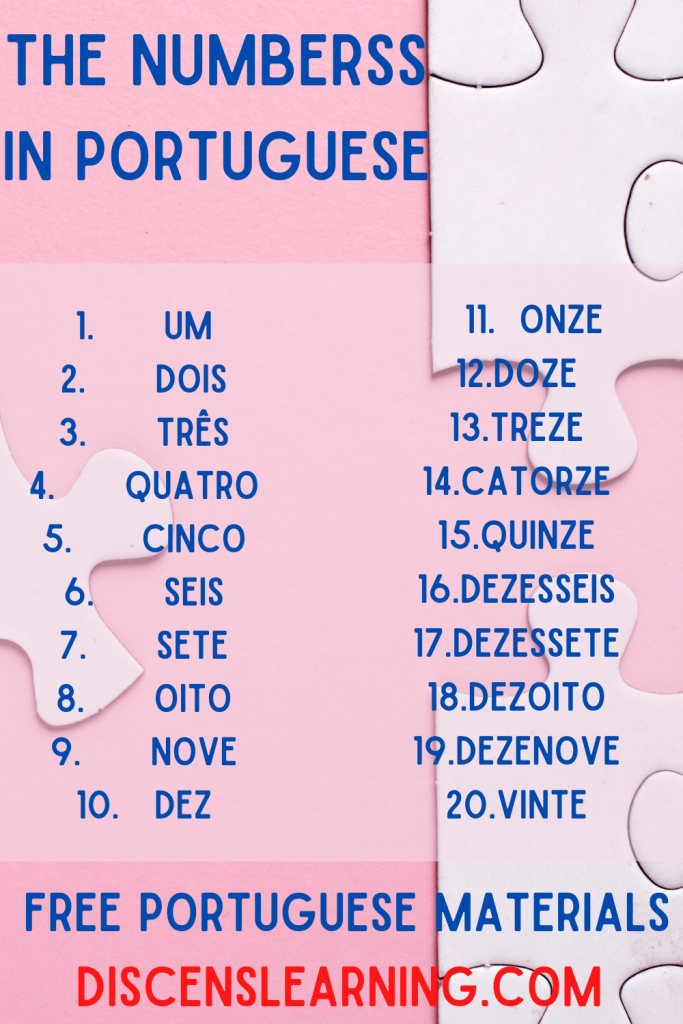
In this video you will learn the numbers up to 100 in Portuguese.
| zero | 0 |
| um | 1 |
| dois | 2 |
| três | 3 |
| quatro | 4 |
| cinco | 5 |
| seis | 6 |
| sete | 7 |
| oito | 8 |
| nove | 9 |
| dez | 10 |
| vinte | 20 |
| trinta | 30 |
| quarenta | 40 |
| cinquenta | 50 |
| sessenta | 60 |
| setenta | 70 |
| oitenta | 80 |
| noventa | 90 |
| cem | 100 |
You must learn the numbers 0-9 because they are the basis for building the other numbers.
Between 11 and 15, the numbers are irregular. You must learn them, too.
Between 16 and the 19, we follow the same reasoning: first the ten, then the one.
- 16: DEZESSEIS (DEZ + SEIS)
- 19: DEZENOVE (DEZ + NOVE)
The tens in Portuguese are:
| dez | 10 |
| vinte | 20 |
| trinta | 30 |
| quarenta | 40 |
| cinquenta | 50 |
| sessenta | 60 |
| setenta | 70 |
| oitenta | 80 |
| noventa | 90 |
the tens in Portuguese
After the number 20, we separate the words.
21: VINTE E UM (VINTE + UM)
33: TRINTA E TRÊS (TRINTA + TRÊS)
47: QUARENTA E SETE (QUARENTA + SETE)
Do you see? Everything is very logical. You must practice the numbers and, therefore, you have here interactive cards with all the numbers up to 100. You can choose the learning or gaming mode you prefer, and you will see that it is very enjoyable to practice Portuguese this way.
Learn all the numbers in Portuguese (0-100) for FREE with audio and flashcards!
| 0 | zero |
| 1 | um |
| 2 | dois |
| 3 | três |
| 4 | quatro |
| 5 | cinco |
| 6 | seis |
| 7 | sete |
| 8 | oito |
| 9 | nove |
| 10 | dez |
| 11 | onze |
| 12 | doze |
| 13 | treze |
| 14 | catorze / quatorze |
| 15 | quinze |
| 16 | dezesseis |
| 17 | dezessete |
| 18 | dezoito |
| 19 | dezenove |
| 20 | vinte |
| 21 | vinte e um |
| 22 | vinte e dois |
| 23 | vinte e três |
| 24 | vinte e quatro |
| 25 | vinte e cinco |
| 26 | vinte e seis |
| 27 | vinte e sete |
| 28 | vinte e oito |
| 29 | vinte e nove |
| 30 | trinta |
| 31 | trinta e um |
| 32 | trinta e dois |
| 33 | trinta e três |
| 34 | trinta e quatro |
| 35 | trinta e cinco |
| 36 | trinta e seis |
| 37 | trinta e sete |
| 38 | trinta e oito |
| 39 | trinta e nove |
| 40 | quarenta |
| 41 | quarenta e um |
| 42 | quarenta e dois |
| 43 | quarenta e três |
| 44 | quarenta e quatro |
| 45 | quarenta e cinco |
| 46 | quarenta e seis |
| 47 | quarenta e sete |
| 48 | quarenta e oito |
| 49 | quarenta e nove |
| 50 | cinquenta |
| 51 | cinquenta e um |
| 52 | cinquenta e dois |
| 53 | cinquenta e três |
| 54 | cinquenta e quatro |
| 55 | cinquenta e cinco |
| 56 | cinquenta e seis |
| 57 | cinquenta e sete |
| 58 | cinquenta e oito |
| 59 | cinquenta e nove |
| 60 | sessenta |
| 61 | sessenta e um |
| 62 | sessenta e dois |
| 63 | sessenta e três |
| 64 | sessenta e quatro |
| 65 | sessenta e cinco |
| 66 | Sessenta e seis |
| 67 | sessenta e sete |
| 68 | sessenta e oito |
| 69 | sessenta e nove |
| 70 | setenta |
| 71 | setenta e um |
| 72 | setenta e dois |
| 73 | Setenta e três |
| 74 | setenta e quatro |
| 75 | setenta e cinco |
| 76 | setenta e seis |
| 77 | setenta e sete |
| 78 | setenta e oito |
| 79 | setenta e nove |
| 80 | oitenta |
| 81 | oitenta e um |
| 82 | oitenta e dois |
| 83 | oitenta e três |
| 84 | oitenta e quatro |
| 85 | oitenta e cinco |
| 86 | oitenta e seis |
| 87 | oitenta e sete |
| 88 | oitenta e oito |
| 89 | oitenta e nove |
| 90 | noventa |
| 91 | noventa e um |
| 92 | noventa e dois |
| 93 | noventa e três |
| 94 | noventa e quatro |
| 95 | noventa e cinco |
| 96 | noventa e seis |
| 97 | noventa e sete |
| 98 | noventa e oito |
| 99 | noventa e nove |
| 100 | cem |
Video 6. How to talk about time in Portuguese
In this video you will learn useful phrases to indicate the date and time.
| Que dia é hoje? | What day is today? |
| Hoje é segunda-feira, dia 6 de julho. | Today is Monday, the sixth of July. |
| Que horas são? | What time is it? |
| São onze da manhã. | It is eleven in the morning. |
| Você tem tempo para um café? | Do you have time for a coffee? |
| Sim, eu tenho tempo. | Yes, I have time. |
| Não, sinto muito. Agora estou ocupada. | No, I am sorry. Now I am busy. |
You will learn that, to ask about the date, you will ask in Portuguese “QUE DIA É HOJE?”.
To ask for the time, the question in Portuguese is “QUE HORAS SÃO?”.
- 01:00 AM or PM: we answer “É UMA (HORA)”
- 02:00 AM or PM, 03:00 AM or PM, etc.: we answer “SÃO …”
It is quite logical, isn’t it? Because the number 1 is singular, that is why the verb to indicate the time is “É” (“it is”). If the clock strikes any other time, we will use the plural verb (“SÃO”, “they are”).
To ask someone if they want to do something with you, you can do it this way:
- “VOCÊ TEM TEMPO PARA…?”. After “PARA” (“to”, “for”), you add the verb in infinitive.
Do you want to learn the vocabulary of the most relevant verbs in Portuguese? You have a video and PDF material to download for free here.
Free Video Guide: Portuguese Verbs for English Speakers
| TER | |
| EU | TENHO |
| VOCÊ / O SENHOR / A SENHORA | TEM |
| Não, sinto muito. Agora estou ocupada. | No, I am sorry. Now I am busy. |
You will see that this sentence includes the apology (“SINTO MUITO”) and the reason for rejecting the invitation (“ESTOU OCUPADA”).
| João is busy. | |
| João says: “I’m busy” | |
| Rosa is busy. | |
| Rosa says: “I’m busy” |
- end with the letter -O if they refer to the masculine
- end with the letter -A if they refer to the feminine
- If a man is being mentioned, we place “O” before his name. “O JOÃO”
- If a woman is being mentioned, we place “A” before her name. “A ROSA”
| She is Rosa. | |
| I am Rosa. | |
| My name is Rosa. |
Do you want to learn how to make a proposal or invitation in Portuguese and how to react to that offer? You have a video with free PDF material to download that will help you communicate better. You will learn to make invitations from the 52:10 minute of the video:
If you want to expand your vocabulary with words related to time, you can learn them starting on minute 10:19 of the video of the guide on basic nouns in Portuguese for English speakers, which includes free material to practice and download.
| a semana | the week |
| segunda-feira | Monday |
| terça-feira | Tuesday |
| quarta-feira | Wednesday |
| quinta-feira | Thursday |
| sexta-feira | Friday |
| o fim de semana | weekend |
| sábado | Saturday |
| domingo | Sunday |
| o ano | the year |
| os meses | the months |
| janeiro | January |
| fevereiro | February |
| março | March |
| abril | April |
| maio | May |
| junho | June |
| julho | July |
| agosto | August |
| setembro | September |
| outubro | October |
| novembro | November |
| dezembro | December |
15 ?
27?
54 ?
83 ?
96 ?
Video 7. How to talk about your spare time in Portuguese
In this video you will learn simple phrases to talk about your leisure activities. It is an enjoyable topic and suitable for chatting in Portuguese with people you do not know very well.
| Você tem passatempos? | Do you have hobbies? |
| Os meus passatempos são a música e o esporte. | My hobbies are music and sport. |
| Eu não tenho muito tempo livre. | I do not have much spare time. |
| No tempo livre, eu prefiro descansar. | In the spare time, I prefer to rest. |
| Eu não gosto muito de ler. | I don’t really like reading. |
First of all, notice the synonyms:
| TEMPO LIVRE, LAZER | spare time |
| PASSATEMPO, HOBBY | hobby |
vocabulary about hobbies in Portuguese
To state your hobbies in Portuguese…
- If you want to mention a single hobby you have, you will say “(O) MEU PASSATEMPO É…”
- If you have two or more hobbies you want to list, you will say “(OS) MEUS PASSATEMPOS SÃO… “
The article before the possessive is optional. I explain this aspect of the Portuguese language with more examples in the comment of video 8.
Your hobbies can be:
| verb (infinitive) | MEUS PASSATEMPOS SÃO DANÇAR E TOCAR VIOLÃO. |
| noun | MEUS PASSATEMPOS SÃO A DANÇA E O VIOLÃO. |
how to mention your hobbies in Portuguese
In Portuguese the verb “GOSTAR” is quite simple.
- If you want to intensify how much you like something, you will say “EU GOSTO MUITO… ” .
- To deny, you will say “EU NÃO GOSTO…”.
| structure | example | translation |
| GOSTAR DE + infinitive | EU GOSTO DE TOCAR VIOLÃO. | I like playing the guitar. |
| GOSTAR DE + noun | EU GOSTO DE VIOLÃO. | I like the guitar. |
| PREFERIR + infinitive | EU PREFIRO TOCAR GUITARRA. | I prefer to play the electric guitar. |
| PREFERIR + noun | EU PREFIRO GUITARRA. | I prefer the electric guitar. |
how to use the verb “GOSTAR” (“to like”) in Portuguese
| DE + verb (infinitive) | EU GOSTO DE TRABALHAR. |
| DE + noun (general) | EU GOSTO DE CAFÉ. |
| DO + masculine noun (specific) | EU GOSTO DO CAFÉ GOURMET. |
| DE + noun (general) | EU GOSTO DE MÚSICA. |
| DA + feminine noun (specific) | EU GOSTO DA MÚSICA BRASILEIRA. |
You can also use the verbs “GOSTAR” and “PREFERIR” to talk about likes and preferences. You have examples of these verbs in this video, starting on minute 47:32.
Video 8. How to talk about your home in Portuguese
In this video you will learn how to describe your housing situation.
| Onde você mora? | Where you live? |
| Eu moro em uma cidade grande. | I live in a big city. |
| Eu moro na rua Paris, número 20, apartamento 4A. | I live in the street Paris, number 20, apartment 4A. |
| Eu moro no centro da cidade. | I live in the city center. |
| Eu moro com a minha família. | I live with my family. |
| VOCÊ | ONDE VOCÊ MORA? |
| O SENHOR | ONDE O SENHOR MORA? |
| A SENHORA | ONDE A SENHORA MORA? |
You will say “EU MORO EM…” and you will add your city, neighborhood or even your address.
In Portuguese, as you have already seen, you must place the article before the names of countries (masculine, “O”, feminine, “A”). But cities no not require article. The most important exceptions are the following:
- countries without article: PORTUGAL, MOÇAMBIQUE, ANGOLA
- cities with article: O RIO DE JANEIRO, O PORTO
Notice that in Portuguese there is a difference between the verb “VIVER” (“to live, to exist”) and “MORAR” (“to inhabit”). If you refer to the place where you reside, you will preferably use “MORAR” in Portuguese.
To indicate who you live with, you will simply say “MORO COM…”. Examples:
| MORO SOZINHO. | I live alone. (if you are a man) |
| MORO SOZINHA. | I live alone. (if you are a woman) |
| MORO COM (A) MINHA FAMÍLIA. | I live with my family. |
| MORO COM (OS) MEUS PAIS. | I live with my parents. |
| MORO COM AMIGOS. | I live with friends (roomates) |
| MORO COM (O) MEU COMPANHEIRO. / (O) MEU NAMORADO. | I live with my partner. / my boyfriend. |
| MORO COM (A) MINHA COMPANHEIRA. / (A) MINHA NAMORADA. | I live with my partner. / my girlfriend. |
example of phrases to describe your living situation in Portuguese
Notice that in Portuguese it is possible to place the article in front of the possessive. Example:
| MEU TRABALHO | my job |
| O MEU TRABALHO | my job |
| MINHA FAMÍLIA | my family |
| A MINHA FAMÍLIA | my family |
the possessives in Portuguese
All these phrases are correct. In Portuguese, the article in front of the possessive is optional and has an emphatic value. The article makes the possessive stand out.
Video 9. How to talk about daily habits in Portuguese
In this video you will learn to narrate your routine.
| Eu acordo às seis da manhã. | I wake up at six AM. |
| Eu trabalho de segunda a sexta-feira. | I work from Monday to Friday. |
| Eu faço esporte todos os dias. | I exercise every day. |
| De noite eu descanso. | I rest in the evening. |
| Eu vou para a cama às onze da noite. | I go to bed at eleven PM. |
| ACORDAR | to wake up / to stand up |
| TRABALHAR | to work |
| FAZER ESPORTE | to exercise |
| DESCANSAR | to rest |
| IR PARA A CAMA | to go to bed |
| À UMA (1:00) / ÀS DUAS (2:00) | at one o’clock (1:00) / at two o’clock (2:00) |
| DE SEGUNDA A SEXTA | Monday to Friday |
| TODOS OS DIAS | every day |
| DE MANHÃ / PELA MANHÃ | in the morning |
| DE TARDE / À TARDE | in the afternoon |
| DE NOITE / À NOITE | in the evening |
You have more important time expressions in lesson 3 of the Portuguese for English-speaking Beginners mini-course that you can access here without needing to register for the course.
How To Learn Portuguese Online & For Free – Sneak Peek
Video 10. How to talk about your hometown in Portuguese
In this video you will learn how to give information about the city where you live. It is a way to continue the conversation you learned in video 8.
| Eu moro em uma cidade grande. | I live in a big city. |
| A cidade está tranquila agora. | The city is quiet now. |
| É muito cedo. | It is very early. |
| Há pouco tráfego e pouco barulho. | There is little traffic and little noise. |
| Não há muita gente na rua. | There are not many people on the street. |
”TRANQUILO/A” is a very practical adjective in Portuguese. In Portuguese, the letter U in the combinations QUE and QUI is written, but it is not pronounced.
- That is the general rule, but in words like “CINQUENTA” (the number 50) or “TRANQUILO/A” the letter U will be pronounced.
In the video I use “TRANQUILO/A” to define the city, but you can also use it to describe to a person, a situation …
| O JOÃO É UM GAROTO TRANQUILO. | João is a quiet boy. |
| EU MORO EM UMA CIDADE TRANQUILA. | I live in a quiet city. |
| HOJE É UM DIA TRANQUILO. | Today is a quiet day. |
example phrases with the adjective “TRANQUILO/A” in Portuguese
I already told you a little about adjectives in Portuguese in the comment on video 6. Do not forget:
- If the adjective refers to a singular masculine noun, we will use “TRANQUILO”: “GAROTO TRANQUILO”
- If the adjective refers to a singular feminine noun, we will use “TRANQUILA”: “GAROTA TRANQUILA”
”TRANQUILO/A” is an adjective that can be combined with both the verb “SER” and “ESTAR”. Both verbs in English translate as “to be”. Depending of the verb we use (“SER” or “ESTAR”) the adjective “TRANQUILO” has the same meaning (“quiet”, “calm”)… But in Portuguese there is a difference:
- If I say “A CIDADE É TRANQUILA” (with the verb “SER”), I mean that in general it is a city where there is not much going on.
- If I say “A CIDADE ESTÁ TRANQUILA” (with the verb “ESTAR”) there are two possible meanings. 1) The city is not quiet normally, but now it is; 2) The city is normally quiet, and now it is even quieter than normal.
The nuances that an adjective acquires, according to whether we combine it with “SER” and with “ESTAR”, is a fascinating topic! Many adjectives in Portuguese work like this. I will delve into the difference between the verbs “SER” and “ESTAR” in the comment of video #11. Another aspect that you should notice in the video is the verbal form “HÁ”, which is the equivalent in Portuguese of “there is” / “there are”. In Portuguese it is correct to use “HÁ”, but in everyday life, instead of “HÁ”, we use “TEM”. You can combine “HÁ” / “TEM” with a singular or a plural noun. Observe the difference between “MUITO” (invariable) and “MUITO/A/OS/AS” (variable). “MUITO” in Portuguese refers to an adjective (“MUITO TRANQUILA”) or an adverb (“MUITO CEDO”). It is invariable. ”MUITO” is also invariable if it refers to a verb: “SINTO MUITO”. “MUITO”, referring to a noun, agrees with it, so “MUIT-“ will have the endings “-O” (masculine, singular), “-A” (feminine, singular), “-OS” (masculine, plural), “-AS” (feminine, plural).
| masculino, singular | MUITO TEMPO | much time |
| feminino, singular | MUITA CHUVA | a lot of rain |
| masculino, plural | MUITOS LIVROS | many books |
| feminino, plural | MUITAS FAMÍLIAS | many families |
“MUITO” with nouns in Portuguese
Here are the interactive flashcards with the expressions from the videos #7 to #10 to practice. You can choose your preferred learning or gaming mode.
Video #11. How to talk about sickness and health in Portuguese
No one enjoys being ill, but sometimes it cannot be helped. In this video you learn some phrases to talk about this topic if necessary.- Hopefully you do not need to use these phrases on your next vacation in a Portuguese-speaking country but, if it happens, you have this quick guide to help you.
| Eu não estou bem. Estou doente. | I am not well. I am ill. |
| Eu preciso comprar medicamentos. | I need to buy medicine. |
| Eu compro medicamentos na farmácia. | I buy medicine in the pharmacy. |
| Depois eu vou ao hospital. | Then, I go to the hospital. |
| Eu tenho uma consulta com o médico. | I have a doctor’s appointment. |
How we use “BEM” and “MAL” in Portuguese
To ask how a person is doing – in general – you will say in Portuguese “COMO VAI?” (= “how are you doing?”).
- You can use this short phrase in any situation (formal / informal) and with anyone (man / woman).
It is also possible to ask “TUDO BEM?” (“everything OK?”) and this structure has endless variations, like “TUDO BOM?”, “TUDO CERTO?”, and so on. You can learn the most important Brazilian conversation starters in this guide with video, PDF, audio, and quiz.
In English, if someone asks “how are you doing?”, you can answer “(I am doing) well” or, casually, “(I am) good”. “Well” is an adverb and “good” an adjective, and both can be used in English in this situation.
- But in Portuguese things are different! To que question “COMO VAI?” the answer with the verb “ESTAR” (“I am”) will always be an adverb – either “BEM”, if you are doing well, or “MAL” if you are not well.
- In Portuguese you do not answer “EU SOU BOM /EU SOU BOA ” or “EU SOU MAU /EU SOU MÁ” if someone asks you “COMO VAI?”. The grammar of these sentences is correct, but they are not adequate in this situation.
“ESTOU BEM” and “ESTOU MAL” are the most general responses to “COMO VAI?” in Portuguese: you can use them if someone asks you “COMO VAI?”. “ESTOU” is the first person of the singular of the verb “ESTAR”.
- You can answer plainly “BEM” and “MAL” (omitting the “(EU) ESTOU”).
”BEM” and “MAL” are adverbs, so they are invariable. It does not matter if you are male or female, you will use “BEM” and “MAL” referring to your current state without changing anything.
But you will never say “SOU MAL” or “SOU BEM.” They will understand you, but it is not correct in Portuguese. “BEM” and “MAL” are incompatible with the verb “SER”.
If you want to be more specific, to ask about someone’s health you will say ” DE SAÚDE, COMO VAI?” or “DE SAÚDE, TUDO BEM?”.
| DE SAÚDE, COMO VAI? | How are you doing (health-wise)? |
| DE SAÚDE, TUDO BEM? | Everything OK (health-wise)? |
| COMO VOCÊ ESTÁ DE SAÚDE? | How are you (health-wise)? |
| COMO VOCÊ ESTÁ SE SENTINDO? | How do you feel? |
- They are synonyms and both are reflexive verbs – just like the verb “CHAMAR-SE”.
- In Portuguese, “EU ME CHAMO” is literally, “I call myself”, but English does not phrase “my name is” this way.
- That is, when you conjugate reflexive verbs – such as “SENTIR-SE” and “ENCONTRAR-SE” – do not forget to include the pronoun: “ME” for the person “EU”.
| EU | translation |
| EU ME SINTO / EU ME ENCONTRO | I feel |
- They are synonyms and both are reflexive verbs – just like the verb “CHAMAR-SE”.
- In Portuguese, “EU ME CHAMO” is literally, “I call myself”, but English does not phrase “my name is” this way.
- That is, when you conjugate reflexive verbs – such as “SENTIR-SE” and “ENCONTRAR-SE” – do not forget to include the pronoun: “ME” for the person “EU”.
| EU | translation |
| EU ME SINTO / EU ME ENCONTRO | I feel |
Notice that in Portuguese we can talk about something that happens in the present in two ways:
- Conjugating the verb in the present.
- Conjugating the verb “ESTAR” + the verb in gerund. The corresponding structure in English is the present continuous, like “I am feeling”.
| INFINITIVO | EU | translation |
| SENTIR-SE (PRESENTE) | EU ME SINTO | I feel |
| SENTIR-SE (ESTAR+ GERÚNDIO) | EU ESTOU ME SENTINDO | I am feeling |
To indicate that you are not in good health, you have several ways to express that in Portuguese:
| ESTOU ME SENTINDO MAL. | I am unwell. |
| NÃO ESTOU ME SENTINDO BEM. | I am not feeling well. |
| ESTOU MUITO MAL. | I am really unwell. |
| NÃO AGUENTO MAIS. | I cannot stand it. |
| … ESTÁ DOENDO. | … is hurting. |
| ESTOU COM DOR DE … . | I have … ache. |
Of course, the negative “NÃO” will be used if you want to use a negative sentence. To make the sentence positive, you remove “NÃO”: “ESTOU ME SENTINDO BEM” (“I feel well”), for example.
“ESTAR”, “ENCONTRAR-SE” and “SENTIR-SE” are synonyms in this case. But since “ENCONTRAR-SE” and “SENTIR-SE” are reflexive verbs, you will use a special structure with them.
| INFINITIVO | EU | translation |
| SENTIR-SE (PRESENTE) | EU ME SINTO | I feel |
| SENTIR-SE (ESTAR+ GERÚNDIO) | EU ESTOU ME SENTINDO | I am feeling |
What is the difference between “BEM” and “BOM/BOA” and “MAL” and “MAU/MÁ” in Portuguese?
”BEM” and “MAL” have opposite meanings in Portuguese.- “BEM” is positive, and “MAL” is negative.
- “BOM”/”BOA” is positive, “MAU”/”MÁ” is negative.
| ADVÉRBIO | ADJETIVO MASCULINO | ADJETIVO FEMENINO | |
| BEM | BOM | BOA | |
| MAL | MAU | MÁ |
These adjectives, as you can see, can be placed before the noun to which they refer, or after this noun.
In Portuguese, the adjective “MAU/MÁ” has a widely used synonym, which is “RUIM” (invariable for masculine/feminine).
- The difference is that “MAU/MÁ” is more general.
- “RUIM” (pronounced “RU-IM”, stressing the last syllable), on the other hand, is mostly used for something that is unpleasant to the senses, or for something morally reprehensible.
But this is just an orientation, it is not a rule, and you will see that often both adjectives are used as synonyms.
The difference between these two pairs is as follows:
“BEM” and “MAL” are adverbs. They refer to verbs and are invariable:
| O MARCOS DORME MAL. | Marcos sleeps poorly. |
| A JÚLIA FALA BEM INGLÊS. | Julia speaks English well. |
- “MAL” is characterizing the action of “sleeping,” and “BEM” positively describes the action of “speaking”.
- We could change the phrases, but “BEM” and “MAL” do not vary.
| O MARCOS DORME BEM. | Marcos sleeps well. |
| A JÚLIA FALA MAL INGLÊS. | Julia speaks English poorly. |
“BOM/BOA” and “MAU/MÁ” are adjectives. They refer to nouns.
| O MARCOS É UM MAU MENINO. | Marcos is a bad boy. |
| A JÚLIA É UMA BOA MENINA. | Julia is a good girl. |
- “MAU” (masculine, singular) refers to “(O) MENINO” (masculine, singular).
- “BOA” (feminine, singular) refers to “(A) MENINA” (feminine, singular).
If we change the meaning, we must change the grammar, too:
| O MARCOS É UM BOM MENINO. | Marcos is a good guy. |
| A JÚLIA É UMA MÁ MENINA. | Julia is a bad girl. |
| CORRETO | O MARCOS ESTUDA BEM. | Marcos studies well. |
| CORRETO | O MARCOS ESTÁ BEM. | Marcos is well. |
| INCORRETO | wrong |
| CORRETO | Marcos is a bad boy. | |
| CORRETO | Marcos is evil. | |
| INCORRETO | incorrect |
Phrases 1 and 2 have the same meaning: “Marcos is a bad guy”.
The third phrase is not correct. You could say “O MARCOS ESTÁ MAL” if you mean that he is not doing well.
Attention: “BOM/BOA” and “MAU/MÁ” can refer to persons, as you have just seen, but they are also used to describe situations, things, places, etc.
Beware: to intensify, you can say “(É/ESTÁ) MUITO BOM/BOA” and “(É/ESTÁ) MAU/MÁ”. You can also say “(ESTÁ) MUITO BEM” and “(ESTÁ) MUITO MAL” The following phrases are wrong:
- “
NÃO BOM“: a verb is missing, for example, “O CAFÉ NÃO ESTÁ BOM” - “
NÃO BEM“: a verb is missing, for example, “O MARCOS NÃO ESTUDA BEM”
To indicate that a meal tastes good in Portuguese, you can use:
- the adjective “BOM/BOA” (with the verb “ESTAR”). It is general.
- the adjective “GOSTOSO/A”. It indicates that something tastes good.
- “GOSTOSO/A” is also used – colloquially – to indicate that a person is attractive (he is so attractive that you want to have a taste of him/her, literally).
How to say to a person “you are hot” (= sexy) in Portuguese? “Hot” is “QUENTE”, but it is not used in this sense in Portuguese. In Brazil:
- “VOCÊ É ATRAENTE”: you say that to a man or a woman and it is a bit formal and objective. It is like a politically correct way of stating that someone is attractive.
- “VOCÊ É GOSTOSO” : this is what you say to a man if you consider him sexy.
- “VOCÊ É GOSTOSA” : this is what you say to a woman if you consider her sexy.
You must be careful in what situation and to which person you say “VOCÊ É GOSTOSO/A”, since it is a compliment regarding solely their physique. In a work environment, for example, it is inadequate to use such compliments. Although you are saying something positive (the person has an amazing body), he or she may feel offended, feeling objectified.
You will learn more phrases to flirt in Portuguese starting on minute 07:34 of this video where I teach you the most googled Portuguese words and phrases.
What is the difference between “SER” and “ESTAR” in Portuguese?
In Portuguese, the verb “SER” is used for definitions. The verb “SER” defines stable characteristics of something or someone.- “SER” is used to speak in a general manner about something that is always (or almost always) in a certain way. “SOU UMA PESSOA FELIZ.”
- In English, “SER” is translated as “to be”. But “ESTAR” is “to be”, as well!
- Native speakers have no difficulty interpreting those subtleties.
- You, as a foreigner, will not have problems with that when you have a little more experience with Portuguese. You only have to practice a little.
| VERBO | how to use it | EXEMPLO | translation |
| SER | general traits | EU SOU UMA PESSOA FELIZ. | I am a happy person. |
| ESTAR | current situation | É SEXTA-FEIRA, ESTOU FELIZ! | It is Friday, I am happy! |
| ESTAR | location (person) | ESTOU EM CASA. | I am at home. |
| ESTAR | location (place) | PORTUGAL ESTÁ NA EUROPA. | Portugal is in Europe. |
”FELIZ” is an adjective meaning “happy”. It is compatible with the verbs “SER” and “ESTAR”.
The meaning of “FELIZ” is the same if I say “SOU FELIZ” (verb “SER”) and “ESTOU FELIZ” (verb “ESTAR”). The difference is:
- “SOU FELIZ” means that I am always happy, in general, in any circumstance.
- “ESTOU FELIZ” has two possible interpretations:
- Overall, I am not happy, but right now, I am happy.
- Overall, I am happy, and right now, I am even happier than usual.
It will be easier with a couple of visual examples.
“AS LHAMAS SÃO FELIZES.” It is a definition. Do you see them, frolicking, in sheer joy? That is the way they are, always.
“A LHAMA ESTÁ FELIZ.” This is especially so right now. This llama is very happy today because it is its birthday.
There are adjectives that can only be used with “ESTAR” because, by definition, they are current statuses or situations.
For example: “ASSUSTADO/A” (“scared”) or “SURPRESO/A” (“surprised”) are adjective that describe a state. A situation leads us to that state, but when the circumstance changes, we leave that state.
“OS COELHINHOS ESTÃO ASSUSTADOS.”
The verb “ESTAR” is also used to talk about location. That is, it indicates the place where someone or something is placed – momentarily or definitely.
- The verb “ESTAR” is used to mention the location of persons and objects with the preposition “EM”: “ESTOU EM CASA”.
- “ESTAR” also indicates the location of things that cannot be placed somewhere else, such as a country: “PORTUGAL ESTÁ NA EUROPA”.
- In English “ESTAR” translates mainly as “to be”. Depending on the context, “ESTAR” can also mean “to feel” or “to be located”.
- In this case you can also say “PORTUGAL FICA NA EUROPA”, it is more common. “FICAR” has many meanings in Portuguese. In this case, it has the purpose of indicating the location.
What adjectives are used with “SER” and “ESTAR” in Portuguese?
Most adjectives in Portuguese admit both verbs: “SER” and “ESTAR”. The speaker is the one who decides whether to use the verb “SER” or the verb “ESTAR” depending on his/her intentions.- That is, almost all Portuguese adjectives can be combined with “SER” and “ESTAR”, without there being a significant change in their meaning.
- Only a nuance of its meaning changes:
- With “SER”, we indicate that this feature is general and permanent.
- With “ESTAR”, we indicate that this feature is momentary and specific.
- If the speaker wants to highlight general features of something or someone, he/she will use the verb “SER”.
- If the speaker wants to qualify that it is a specific and/or a temporary characteristic of something or someone, he/she will prefer the verb “ESTAR”.
- But “BOM/BOA” and “MAU/MÁ” are peculiar adjectives because they can also be placed before the noun.
Talking about health in Portuguese: Vocabulary and useful phrases
After this explanation, let us focus on your health. You learned above some expressions to indicate how you feel. We will analyze them a little.| singular + ESTÁ DOENDO | singular + is hurting |
| plural + ESTÃO DOENDO | plural + are hurting |
| ESTOU COM DOR DE + substantivo | I have (noun)-ache |
- “…ESTÁ DOENDO” is the phrase you use to indicate that a part of the body hurts.
- It is singular, and that is why you will say “A MINHA CABEÇA ESTÁ DOENDO.”
- In the plural, you will say “…ESTÃO DOENDO”.
- For example, “OS MEUS DENTES ESTÃO DOENDO.”
- Another way to indicate pain is “ESTOU COM DOR DE…”.
- For example, “ESTOU COM DOR DE CABEÇA.”
- To simplify, you can simply say “ESTÁ DOENDO AQUI” and point your finger at which part of your body hurts.
| AS DORES NO CORPO | body aches |
| A DOR DE CABEÇA | headache |
| A DOR DE BARRIGA | stomach ache |
| A DOR DE DENTE | toothache |
| A TONTURA | dizziness |
| O VÔMITO | vomit |
| A DIARRÉIA | diarrhea |
| O RESFRIADO | cold |
| A GRIPE | flu |
| A FEBRE | fever |
| A DOENÇA | illness |
| O ACIDENTE | accident |
| A AMBULÂNCIA | ambulance |
| PRONTO-SOCORRO | emergency room |
| O REMÉDIO / O MEDICAMENTO | medicine |
| COM/SEM RECEITA | with/without prescription |
| A ALERGIA | allergy |
| O CONSULTÓRIO MÉDICO | doctor’s office |
| O DENTISTA | dentist |
| RECEBER ALTA | to be discharged |
The verb “PRECISAR” in Portuguese
Observe that if you use…“PRECISO” + a verb in infinitive
“PRECISO DE” + a noun
… you are indicating something you must do or something you need. For example:| PRECISO DE AJUDA. | I need help. |
| PRECISO DE UM MÉDICO. | I need a doctor. |
| PRECISO DE UMA CONSULTA COM O DOUTOR. | I need a doctor’s appointment. |
| PRECISO DE UMA AMBULÂNCIA. | I need an ambulance. |
| PRECISO IR AO PRONTO-SOCORRO. | I need to go to the ER. |
”PRECISO” + infinitive or noun is useful to talk about your health, but also to talk about anything you need, really!
- Therefore, you can recycle this structure to order something in the restaurant or in a store, as you will see in the following videos in this series.
| EU PRECISO | I need |
| EU QUERIA | I would like |
| EU QUERO | I want |
| EU GOSTARIA DE | I would like |
The preposition “DE” in Portuguese can be combined with the definite articles (DE + O = DO” / “DE + A = DA”). You will say “PRECISO DE” + article + noun to indicate something very specific that you need.
- “PRECISO DE TEMPO”: “I need time” – not specific (no article)
- “PRECISO DO LIVRO DE PORTUGUÊS” : “I need the Portuguese book” – specific (article included)
- “PRECISO DA CHAVE DE CASA”: “I need the house key” – specific (article included)
Here are the interactive flashcards with the expressions from the video #11 to practice. You can choose your preferred learning or gaming mode.
Here you have a quiz to practice what you learned in the video #11 of this series.
Video #12. How to shop in the market in Portuguese
A very pleasant experience you can have while traveling to a Portuguese-speaking country is to go to a market. You will see products that are different from those you find in your country and you will be able to observe locals in their everyday lives. You can even practice your Portuguese if you decide to buy something! To achieve this, I teach you some useful phrases to make purchases on the market.| Eu preciso comprar frutas e legumes. | I need to buy fruits and vegetables. |
| Eu sempre compro no mercado. | I always shop at the market. |
| Quanto custa o quilo de bananas? | How much does a kilo of bananas cost? |
| Eu queria um quilo de tomates. | I would like to have a kilo of tomatoes. |
| Eu não preciso de mais nada. | I do not need anything else. |
I teach you more useful phrases that you can use in Portuguese in any store, restaurant, or hotel in your daily life or on vacation. These phrases start on minute 31:37 of the video. You have more explanations and free material to download here, with examples and audio.
“NUNCA” and “JAMAIS” in Portuguese
Look at this sentence:SEMPRE COMPRO NO MERCADO.
The negative sentence will be “NUNCA COMPRO NO MERCADO.” But there are two ways to say “never” in Portuguese: “NUNCA” and “JAMAIS”. What is the difference between “NUNCA” and “JAMAIS” in Portuguese? Both can be used to inform facts of the present, past and future in the negative form, but…- “NUNCA” is more common. It is most often used to deny something in the past.
- “JAMAIS” is less common. It is most often used to deny something in the future. “JAMAIS” sounds more dramatic than “NUNCA.”
How to indicate need and desire in Portuguese
Do you see how useful the verb “PRECISAR” is? I showed it to you in the comment to video #11 and here you see it once again.- To place your order in the market, you can say:
- “PRECISO”+ “DE”+ the product
- “QUERÍA” + the product
- “(EU) QUERO”: he is very direct and not very polite. But you will hear it quite often in Brazil.
- “(EU) GOSTARIA DE “: this verb is very polite.
- In either case, it is advisable to add “POR FAVOR” when placing your order.
- But, as you already learned in the comment of video #2, “EU” is optional in Portuguese.
- The subject pronoun “EU” is not required by grammar and is often omitted by native speakers to speed up communication.
- For example, if you are in a store and you buy something, you can indicate that through the verb “LEVAR,” because you take that product somewhere else (to your home).
- “LEVAR” in Portuguese, in this case, can be a synonym for “COMPRAR”.
The verbs “IR” and “VIR” / “TRAZER” and “LEVAR” in Portuguese
The opposite meaning verb to “LEVAR” in Portuguese is “TRAZER”. Many English speakers who learn Portuguese find the pairs of verbs “LEVAR” and “TRAEZR” and the pair “IR” and “VIR” very confusing. But you should not worry, because they are quite simple and with examples everything will be crystal-clear.| IR | VIR | LEVAR | TRAZER |
| VOU | VENHO | LEVO | TRAGO |
| VAI | VEM | LEVA | TRAZ |
The secret of these verbs is:
- “IR” and “LEVAR” always indicate a movement that starts from the speaker and goes in another direction, not towards him/her.
- “VIR” and “TRAZER” always indicate a movement toward the speaker.
- “PAULO, VOU PARA A SUA CASA E LEVO UM BOLO”
- “QUE BOM! VOCE VEM PARA A MINHA CASA E TRAZ UM BOLO!”
- If I am the one who is going to someone else’s home, I say “VOU” and “LEVO” (“IR” / “LEVAR”).
- If it is my friend who invites me to his place, when he talks to me (referring to his own house) he will say “VEM” and “TRAZ” (“VIR” / “TRAZER”).
Shopping in Portuguese: useful phrases for English speakers
Now that you know the verb “LEVAR”, you may be wondering, “How do I ask the price of something in Portuguese?”. To ask the price of an item (in the market or in any store), you will say “QUANTO CUSTA?”.| QUANTO CUSTA + singular? | How much does (singular) cost? |
| QUANTO CUSTAM + plural? | How much do (plural) cost? |
You can point to the object, and so you do not need to name it if you do not know its name.
- If you want to name the object (unit), ask “QUANTO CUSTA A MELANCIA?”
- If you know how to name the objects, you will say: “QUANTO CUSTAM AS CEREJAS?”
- It is colloquial, but Brazilians use “ISSO AÍ” a lot to refer to any object or set of objects.
- “ISSO AÍ!” is also a colloquial way of saying “right!” .
- The expression “É ISSO AÍ” also serves to reaffirm something that was said earlier.
| CINCO QUILOS DE BANANAS = 5 kg |
| QUANTO CUSTA O QUILO DE BANANAS? | How much does a kilo of bananas cost? |
| QUANTO CUSTA UM QUILO DE BANANAS? | How much does a kilo of bananas cost? |
| PREÇO, POR FAVOR? | ask, after pointing to the object |
| UM QUILO, POR FAVOR. | to accept the offer |
| NÃO, OBRIGADO/A. | to decline the offer |
You have the polite expressions in Portuguese in video #3 of this series. The last sentence of the video is “NÃO PRECISO DE MAIS NADA”.
- If you do not buy anything and you do not want to buy anything in a store in the market, you can say:
| EU SÓ QUERIA DAR UMA OLHADINHA, OBRIGADO/A. | I just wanted to look around, thank you. |
| NÃO PRECISO DE NADA, OBRIGADO/A. | I do not need anything, thank you. |
Simple negative and double negative in Portuguese
Why do we have two negative words in the same sentence we just saw, “NÃO PRECISO DE (MAIS) NADA”?- “NÃO PRECISO” is the simple negative. You can add whatever you do not need, like “NÃO PRECISO DE BANANAS”.
- “NÃO PRECISO DE NADA” is the double negative.
- “NÃO PRECISO DE MAIS NADA” indicates that you have already bought something, but do not want anything else.
| (EU) NÃO ENTENDO. I do not understand. (EU) NUNCA ENTENDO (A GRAMÁTICA). I never understand (the grammar). |
- Place “NÃO” or “NUNCA” before the conjugated verb.
- Add a second negative word (“NINGUÉM”, “NADA”, “NUNCA”) after the verb.
- “NÃO”: “no”
- “NUNCA” / “JAMAIS”: “never”
- “NINGUÉM”: “nobody”
- “NADA”: “nothing”
| (EU) NÃO ENTENDO NINGUÉM. | I do not understand anyone. |
| (EU) NUNCA ENTENDO NINGUÉM. | I never understand anyone. |
- We put the first negative before all verbs.
- We place the second negative after the verbs.
| (EU) NÃO POSSO ENTENDER NINGUÉM. | I never can understand anyone. |
| (EU) NUNCA QUERO ENTENDER NADA. | I never want to understand anything. |
You can listen to all these example phrases in the following audio: A trick: the double negative in Portuguese is like a cheese sandwich (omnomnom!). Cheese is the verb (or verbs), and negative words are slices of bread.
- You can have a simple negative, then it is like toast. But that simple negative must always be before the verb.
| INCORRETO | |
| CORRETO | (EU) NÃO ENTENDO NADA. |
You have more communicative resources to make purchases in any Portuguese market in lesson 23 of the Portuguese course level A1.
Helpful tips for shopping in Brazil
- In Brazil, many people refer to “SUPERMERCADO” as “MERCADO” to shorten it. It is not very common to shop in the markets because cities do not usually have one in each neighborhood.
- To buy fresh fruits and vegetables, it is best to go to a “SACOLÃO” (literally: “big bag”) which is a supermarket only for those products that is open every day.
- Or, better and cheaper even, you can go to a “FEIRA LIVRE”, often called just “FEIRA”. It is an open-air market, on different days of the week, where you will find food and much more, and where you best eat Brazilian style “streetfood”.
- The most classic combination is “PASTEL” (fried dough with filling) and “CALDO DE CANA”, pressed sugar cane juice, which is the sweetest drink you can taste in your life.
In Brazil, there are fantastic markets. The most famous is Ver-o-Peso in Belém (Pará), which is a UNESCO world heritage site.
- It is a complex on the shores of the Guajará bay that includes the largest open-air market in Latin America. You will find in the market all kinds of natural products from the Amazon region.
- By the way: in Brazil we do not call the “Brazil nuts” that way, but we call them “CASTANHAS DO PARÁ” (“CASTANHA” = “chestnut”) because they are produced in that Amazon region (“PARÁ”).
If you go to São Paulo, the Mercadão is the obvious choice, where you can taste the specialty of the market, which is a sandwich of melted cheese and 300 (!) grams of mortadella (bologna sausage).
If you are looking for a flea market where you can buy second-hand products and antiques, Brazil does not have much tradition. However, you can find some markets of this type. Read the next paragraphs to make the most of your shopping experience!
Just one tip: Be careful! In the most tourist markets there are usually pickpockets. There are no violent robbers, but if you get distracted, they can take your wallet. Just be wary and enjoy the market experience.
Video #13. Shopping in Portuguese.
If you are going on a trip to a country where Portuguese is spoken, it is very likely that you need or want to buy souvenirs or things for yourself. In the comment of the previous video, you already learned some practical phrases to make purchases.- Here I show you some more expressions to improve your “survival Portuguese”, so you can enjoy your next vacation in a Portuguese-speaking country even more.
| Eu vou ao bazar. É uma loja. | I go to the bazar. It is a store. |
| Na loja vendem muitos produtos. | In the store they sell many products. |
| Eu tenho que comprar coisas para a casa. | I need to buy things for the house. |
| A loja não é cara, é barata. | The store is not expensive, it is cheap. |
| A loja está aberta todos os dias. | The store is open every day. |
Talking about places in Portuguese: how to indicate the destination (“IR +A”)
As you already learned in the comment of video #4, to indicate where you are going in Portuguese, you will say “VOU A”.- “EU VOU” is the verb “IR” and we combine it with the preposition “A” in Portuguese to indicate the destination. “VOU AO BAZAR”.
- We combine the preposition “A” with the article “O” and the result is “AO”.
- We combine the preposition “A” with the article “A” and the result is “À”.
- We also combine the prepositions “DE”, “EM” and “POR” in Portuguese with the articles.
| VOU AO BAZAR. | I go to the shop. |
| VOU À LOJA. | I go to the store. |
| VOU AO BAZAR. = VOU PARA O BAZAR. | I go to the shop. |
| VOU À LOJA. = VOU PARA A LOJA. | I go to the store. |
- That is why, when you hear Brazilians speak, you will notice that they say “PRO” (“PARA + O”)with a masculine noun and “PRA” (“PARA + A”) with a feminine noun.
- For example, “VOU PRO BAZAR” / “VOU PRA LOJA”.
- It is a colloquial way of combining the preposition with the article.
What does “À” mean in Portuguese? How is “À” used?
In the table above (
in the drop-down just above) you learned that we can combine the preposition “A” with the article “A” and the result is “À”.
That accent you see (`) is called “ACENTO GRAVE” and is placed over the letter A, exclusively.
- The result of “A” + “A” is “À”, which we call in Portuguese “A COM CRASE” o “A CRASEADO”.
You have learned that the preposition “A” can be combined with the article “A.”
- As writing “A A” would be a bit weird, in Portuguese we merge both A. The result is “À”.
- The same goes for the feminine plural article “AS”: we combine “A” (preposition) with “AS” (article) and the result is “ÀS”.
| PREPOSIÇÃO | ARTIGO | RESULTADO |
| A | ||
| A |
The preposition “A” in Portuguese is used for many situations. Here I will indicate only the main ones:
The preposition “A” indicates destination. That is why we say “IR À PRAIA”. The same use is given to the preposition “PARA” (“IR PARA A PRAIA”), “to go to the beach”.
“IR PARA A PRAIA” is exactly the same as “IR À PRAIA”, but the first phrase is more colloquial and the second, more cultured.
- A more informal version of even “IR PARA A PRAIA” is “IR PRA PRAIA” (“PARA” +’ “A” = “PRA”).
- I insist: it is colloquial, but it is what Brazilians use most (orally).
The preposition “A” also indicates a person benefiting from an action.
- For example, if I buy flowers from my friend Rosa, the action is to “buy flowers”. The person who executes the action is me and the beneficiary is Rosa.
| I buy flowers for Rosa. |
If there are several people (women) who receive flowers, instead of “À” I will say “ÀS”:
| I buy flower for the friends. |
The preposition “A” indicates the time, as you will learn in video #21. Therefore, when you want to find out what time an event takes place, you ask “A QUE HORAS…? ” and you reply:
- “À UMA.” – if the event will occur at 13:00 or 01:00.
- “ÀS…” – if the event will occur at any other time, for example, “ÀS OITO” (08:00), “ÀS ONZE” (23:00), and so on.
There are more uses of “À”, as in fixed expressions of the language, such as “À VONTADE” (= “willingly, with pleasure”, or also “freely”).
- But with the explanation you just read you already know the basics of combining the preposition “A” with the article “A”.
The main combinations of articles and prepositions in Portuguese
In Portuguese it is very common to combine the preposition with the article. It is not mandatory, but the natives do it very naturally, both orally and in writing. Combining the preposition with the article is not colloquial: it is standard Portuguese.
- Usually prepositions are merged with defined articles (“O”, “A”, “OS”, “AS”).
- Some combinations of preposition and indefinite article (“UM”, “UMA”, “UNS”, “UMAS”) are possible, but they are not as frequent. That is why I will not include them here.
Since this is not a grammar guide, but a communication guide, I indicate in a very general way the main uses of prepositions that are usually combined with articles in Portuguese.
You have already learned a little about this topic (the prepositions in Portuguese) in the comment of video #4.
Look at the example table:
| PREPOSIÇÃO | ARTIGO | RESULTADO |
| DE | ||
| EM | ||
| A | ||
| PARA | ||
| POR |
Remember that in Portuguese we mention country names with the article. It is standard language, it is not colloquial. For example, we say “O BRASIL”.
The preposition “DE” in Portuguese indicates relationship between two elements, for example, possession. Therefore, you will say “A CULTURA DO BRASIL” (= “A CULTURA + DE + O BRASIL”), “Brazil’s culture”.
The preposition “EM” in Portuguese indicates fixed location (i.e. it answers the question “ONDE? “). Therefore, you will say “MORAR NO BRASIL” (= “MORAR + EM + O BRASIL”), “to live in Brazil”.
The preposition “A” in Portuguese indicates – among others – direction, destination (i.e. it answers the question “AONDE?”, “where to?”). Therefore, you will say “IR AO BRASIL” (= “IR + A + O BRAZIL”), “to go to Brazil”.
The preposition “PARA” in Portuguese indicates – among others – address, destination (i.e. answers the question “PARA ONDE? “).
- It is correct to use “PARA” to indicate direction, just like the preposition “A”.
- The difference between the prepositions “PARA” and “A” to indicate place (= destination) in Portuguese is that “PARA” has a more colloquial use, while “A” is a slightly more cultured use.
Although I stated earlier that the combination of preposition and article is NOT something typical of colloquial language, but is standard Portuguese, there is an exception. The combination of “PARA” with the article is an oral and informal use of language.
- Therefore, you will say “IR PRO BRASIL” (= “IR + PARA + O BRASIL”), “to go to Brazil”. Although it is a colloquial way of speaking, you will hear it very often in Brazil.
Do you find it confusing? Do not worry, with the following table everything will be clear.
| PORTUGUÊS NORMAL: A+O / A+A | ||
| PORTUGUÊS MAIS COLOQUIAL: PARA+O / PARA+A | ||
| PORTUGUÊS MUITO COLOQUIAL: PRO / PARA |
The preposition “POR” in Portuguese indicates – among others – cause (i.e. answers the question “POR QUÊ?”, “why?”). Therefore, a patriot will say “VIVER PELO BRASIL” (= “VIVER + POR + O BRASIL”), “to live for Brazil”. “O BRASIL” is the reason for that person’s existence.
In English we would simply say “to live for Brazil”, but in Portuguese it is easy to tell the difference:
- “VIVER PELO BRASIL” (Brazil is why someone is living, their “raison d’être” so to speak, since “POR” in Portuguese indicates the reason)
- “VIVER PARA O BRASIL” (Brazil is the motivation for all of this person’s undertakings, since “PARA” in Portuguese indicates the purpose, among other things).
The preposition “POR” has many more uses and is often taught side to side with the preposition “PARA”.
The difference between “POR” and “PARA” in Portuguese is not difficult, but you should learn it in a systematic and timely manner… As it will happen if you enroll in the comprehensive A1 Portuguese course with webinars, where I teach you that contrast very easily in lesson #11.
If you want to have a small preview of the contrast between “POR” and “PARA” in Portuguese, you can read the comment of video #23 of this guide.
The result of the combinations of prepositions and articles in Portuguese is as follows:
| preposition | article | result |
| DE | ||
| DE | ||
| DE | ||
| DE | ||
| EM | ||
| EM | ||
| EM | ||
| EM | ||
| A | ||
| A | ||
| A | ||
| A | ||
| PARA | ||
| PARA | ||
| PARA | ||
| PARA | ||
| POR | ||
| POR | ||
| POR | ||
| POR |
It has a certain logic, right? You should get familiar with this table to understand Portuguese more easily. You should also incorporate these preposition and article fusions into your Portuguese vocabulary.
Another way to indicate needs in Portuguese: “TER + QUE”
You have seen in this guide the structure “PRECISO” + infinitive or noun (with a noun, the preposition “DE” is mandatory). For example, if you need batteries, you can say:| PRECISO COMPRAR PILHAS. | I need to buy batteries. |
| PRECISO DE PILHAS. | I need batteries. |
- For the person “EU”, you will say: “TENHO QUE” + infinitive.
- You will conjugate the verb “TER” in the present tense and add “QUE” and the verb in infinitive.
- Do not forget “QUE” when using this structure!
- The verb in infinitive indicates the action to be performed. You should not conjugate that verb.
| (EU) (NÃO) TENHO QUE ESTUDAR. | I do (not) need to study. |
| (VOCÊ) (NÃO) TEM QUE ESTUDAR. | You do (not) need to study. |
- … indicate a physical or practical need (such as sleeping, for example).
- … they may indicate a duty (such as working, for example). That is, something that does not need to be done, but if we do not do it, negative consequences follow.
| TER + QUE + INFINITIVO | PRECISAR + INFINITIVO |
| CORRETO | TENHO QUE COMPRAR (PILHAS). |
| INCORRETO |
| TER | |
| EU | TENHO |
| VOCÊ / ELE / ELA | TEM |
| NÓS | TEMOS |
| VOCÊS / ELES / ELAS | TÊM |
What is the difference between “TER” and “HAVER” in Portuguese?
What is the difference between “TER” and “HAVER” in Portuguese?- Although the verb “TER” translates as “to have” in English, in Portuguese there is a second verb, “HAVER”, which also translates as “to have”.
- The verb “HAVER” is an auxiliary verb. It is not used as an independent verb.
- In addition, “HAVER” is not used in Brazil in common speech. “HAVER” is used in literature, in official documents, but not in colloquial Brazilian Portuguese.
- Focus on the verb “TER” because we use it all the time.
| TER | HAVER | |
| independent verb | ||
| auxiliary verb |
Common expressions with the verb “TER” in Portuguese
You already know that the verb “TER” in Portuguese is used in the structure “TER + QUE” + infinitive. But “TER” can also be used as an independent verb, accompanying a noun. The most common expressions with this verb are:| TENHO X ANOS. | I am X years old. |
| TENHO VONTADE DE X. / ESTOU COM VONTADE DE X. | I feel like X. |
| TENHO RAZÃO. | I am right. |
| TENHO PRESSA./ ESTOU COM PRESSA. | I am in a hurry. |
| TENHO SONO. / ESTOU COM SONO. | I am sleepy. |
| TENHO FOME. / ESTOU COM FOME. | I am hungry. |
| TENHO SEDE. / ESTOU COM SEDE. | I am thirsty. |
| TENHO FRIO. / ESTOU COM FRIO. | I am cold. |
| TENHO CALOR./ ESTOU COM CALOR. | I am hot. |
| ESTOU COM VONTADE DE CHOCOLATE. / TENHO VONTADE DE CHOCOLATE. |
| ESTOU COM VONTADE DE COMER CHOCOLATE. / TENHO VONTADE DE CHOCOLATE. |
| INCORRETO | CORRETO | translation |
| ESTÁ QUENTE. / ESTÁ FRIO. | It is hot. / It is cold. | |
| TENHO CALOR. / ESTOU COM CALOR. | I am hot. | |
| TENHO FRIO. / ESTOU COM FRIO. | I am cold. |
| ESTOU COM SONO. PRECISO DORMIR. | I am drowsy. I need to sleep. |
| ESTOU CANSADO/A. PRECISO DESCANSAR. | I am tired. I need to rest. |
Observe that in Portuguese they are two different words: “O SONO” (“the sleep”) and “O SONHO” (“the dream”). “O SONHO” in Brazil is also a ball-shaped doughnut kind of pastry, filled with custard, that you can buy in any bakery (you can, and you should, since it is simply delicious!).
The verb “PODER” in Portuguese and the contrast with “SABER”
Another essential verb in Portuguese is “PODER”, which we conjugate and combine with a verb in infinitive. “PODER” is not combined with a noun. Look at the table:| INFINITIVO | SUBSTANTIVO | |
| PRECISO (PRECISAR) | ||
| TENHO QUE (TER QUE) | ||
| POSSO (PODER) |
| PODER | |
| EU | POSSO |
| VOCÊ/ELE/ELA | PODE |
| NÓS | PODEMOS |
| VOCÊS/ELES/ELAS | PODEM |
The negation will be “NÃO” placed in front of the verb “PODER”.
| NÃO TENHO DINHEIRO. NÃO POSSO PAGAR. | I do not have money. I cannot pay. |
- That something is possible because the conditions for its realization are given.
| TENHO DINHEIRO. POSSO PAGAR. | I have money. I can pay. |
- That something is not forbidden, that is, it is allowed.
| TENHO PASSAPORTE. POSSO VIAJAR. | I have a passport. I can travel. |
- That the person is capable to do something (for example, he or she has the necessary physical or mental abilities).
| POSSO FALAR INGLÊS. | I can speak English. |
| SEI FALAR INGLÊS. | I can speak English. |
- “EU SEI ” means “I know.” It is the verb “SABER” in Portuguese, which is only irregular in the present for the 1st person singular.
- “SABER” is used to indicate knowledge.
| SEI A VERDADE. | I know the truth. |
| POSSO FALAR INGLÊS. | I can speak English. |
| SEI FALAR INGLÊS. | I can speak English. |
- If you want to highlight that you learned (mostly) through experience, you will use “PODER”.
- If you want to emphasize that you have some kind of education in this matter, you will use “SABER”.
More adjectives in Portuguese
Notice that the adjectives in the video, “CARO/A” and “BARATO/A”, are opposites. You will change the ending, depending on whether you are referring to an object that has a masculine or a feminine (grammar) gender.| MASCULINO | FEMININO |
| UM CELULAR CARO | UMA CAMISETA CARA |
| UM CELULAR BARATO | UMA CAMISETA BARATA |
- In Brazil: “CAMISETA” and “CELULAR”
- In Portugal: “CAMISOLA” and “TELEMÓVEL”
| O MUSEU ESTÁ ABERTO /FECHADO. | The museum is open/closed. |
| A LOJA ESTÁ ABERTA / FECHADA. | The store is open/closed. |
More helpful tips to go shopping in Brazil
In the neighborhoods in Brazil, you will find at least one “BAZAR”. It is a shop that sells a little bit of everything, cheap household items, stationery, etc., like “everything for a dollar”-stores. Many of these self-service stores became known in the 90s as “LOJA DE 1.99”. Initially all items cost less than 2 reais, but with the rise in prices, the slogan became “DESDE 1.99” (“starting from 1.99”). In this type of store, you can really find any object you may need during your trip.
Video #14. How to buy clothes in Portuguese.
Maybe during your next trip to a Portuguese-speaking country you want to buy some trendy new outfits. Here you will learn some phrases to use in this kind of store.| Eu queria comprar uma camiseta. | I would like to buy a T-shirt. |
| Eu preciso do tamanho M e da cor azul. | I need the size M and the color blue. |
| Quanto custa? | How much does it cost? |
| Posso provar? | Can I try it on? |
| Posso trocar? | I can I exchange? |
| Eu preciso da nota fiscal. | I need the receipt. |
Useful phrases to buy clothes in Portuguese
Do you see? You do not need to speak much Portuguese to accomplish everyday tasks!- You can convey a lot of information using the following verbs that you already learned in this guide and that I list here again:
| INFINITIVO | SUBSTANTIVO | ||
| (EU) (NÃO) QUERO X. | I do (not) want X. | ||
| (EU) (NÃO) QUERIA X. | I would (not) like X. | ||
| (EU) (NÃO) GOSTARIA DE X. | I would (not) like X. | ||
| (EU) (NÃO) PRECISO (DE) X. | I do (not) need X. | ||
| (EU) (NÃO) TENHO QUE X. | I do (not) have to X. | ||
| (EU) (NÃO) POSSO X. | I can(not) X. |
| O PREÇO | the price |
| O TROCO | the change |
| PAGAR EM DINHEIRO | to pay in cash |
| PAGAR À VISTA | to pay cash |
| PAGAR EM PRESTAÇÕES | to pay in installments |
| DEVOLVER | to return |
| TROCAR | to change |
| A NOTA FISCAL | the ticket |
| A FATURA | the invoice |
| A SACOLA | the bag |
| EU TENHO QUE COMPRAR X. TEM X? | I have to buy X. Do you have X? |
| QUANTO CUSTA? | How much does it cost? |
| POSSO PAGAR COM CARTÃO? | Can I pay with card? |
| POSSO PAGAR EM DINHEIRO? | Can I pay in cash? |
| PODE ME DAR A NOTA FISCAL? | Cam I have the ticket? |
| PODE ME DAR UMA SACOLA? | Can I have a bag? |
| POSSO DEVOLVER? | Can I return? |
| POSSO TROCAR? | I can change? |
| QUE CARO! | That is expensive! |
| QUE BARATO! | That is cheap! |
Clothes’ sizes in Brazil: tips for travelers
If you buy clothes in Brazil, you will see that the sizes do not necessarily follow the European or American size standard. We have the following sizes:
P = “small” (= “PEQUENO”)
M = “medium” (= MÉDIO”)
G = “large” (= “GRANDE”)
In Brazil, therefore, we do not call the small size S, but we call it P. If it is a size XS, you will say PP.
The same goes for the plus size: we call it G. A size XL is a GG size in Brazil.
What are the main colors in Portuguese? Vocabulary for English speakers
A color in Portuguese – for example, “VERMELHO” – can be: a noun or an adjective. The meaning is the same (“red”), but from the grammatical point of view there are differences.
Let’s see this little by little. You also have a video where I explain it to you. ***
A color can work as a noun. For example: “O VERMELHO É BONITO.” The nouns that identify colors in Portuguese are ALWAYS masculine: “O BRANCO”, “O VERDE”, “O ROSA”, etc.
You will learn the vocabulary of basic colors in this video (starting on minute 24:17). You have free materials to practice and to download.
| O VESTIDO (MASCULINO, SINGULAR) | O VESTIDO FERMELHO |
| OS SAPATOS (MASCULINO, PLURAL) | OS SAPATOS VERMELHOS |
- The adjective “VERMELHO” refers to a masculine and singular noun.
- The adjective “VERMELHA” refers to a feminine and singular noun.
- The adjective “VERMELHOS” refers to a masculine and plural noun.
- The adjective “VERMELHAS” refers to a feminine and plural noun.
- This is the case of “VERDE/S”. “VERDE/S” refers to a singular noun, no matter if it is masculine or feminine. We cannot say *”
A MAÇÃ VERDA”,it is incorrect. We say “A MAÇÃ VERDE”.
- This is the case of “ROSA”, which always stays the same. “ROSA” refers to any noun, no matter whether it is masculine or feminine, singular or plural.
| MASCULINO, SINGULAR | |
| FEMININO, SINGULAR | |
| MASCULINO, PLURAL | |
| FEMININO, PLURAL |
| MASCULINO, SINGULAR | |
| FEMININO, SINGULAR | |
| MASCULINO, PLURAL | |
| FEMININO, PLURAL |
| MASCULINO, SINGULAR | |
| FEMININO, SINGULAR | |
| MASCULINO, PLURAL | |
| FEMININO, PLURAL |
| VARIAM EM FUNÇÃO DE GÊNERO E NÚMERO | colors that vary, depending on gender and number of the noun they refer to | VARIAM EM FUNÇÃO DE NÚMERO | colors that vary, depending on the number of the noun they refer to | NÃO VARIAM | colors that do not vary |
| BRANCO/A/OS/AS | white | VERDE/VERDES | green | ROSA | pink |
| PRETO/A/OS/AS | black | AZUL/AZUIS | blue | LARANJA | orange |
| VERMELHO/A/OS/AS | red | BEGE/BEGES | beige | VIOLETA/LILÁS | purple |
| AMARELO/A/OS/AS | yellow | MARROM/MARRONS | brown | CINZA | grey |
And these are the basics you must master to talk about colors in Portuguese! Quite easy, right?
Video #15. How to take the public transport and how to ask for direction on the street in Portuguese
If you are travelling to a Portuguese-speaking country, you will most likely need to use public transport. Here you will learn the most useful phrases to reach your destination. Here are some “Survival Portuguese” phrases you can use as a tourist:
| Tenho que ir ao aeroporto. | I have to go to the airport. |
| Tenho que pegar a linha 1 de ônibus e descer no ponto final. | I have to take the bus line 1 and get off at the last stop. |
| A passagem custa dois euros. | The ticket costs two euros. |
| A viagem dura meia hora. | The journey takes half an hour. |
| Eu também posso ir de carro, é mais rápido. | I can also go by car, it is faster. |
You can learn the vocabulary of places and transport in the city. You will find it starting on minute 14:22 of this video. You have free material to download, if you want.
Notice that you will use the preposition “DE” with transport (“DE ÔNIBUS”). If you go on foot instead, you will say “A PÉ”.
- For example, if you are on the outskirts of a city and want to go downtown, you can ask directions with these phrases:
| POSSO IR DE ÔNIBUS AO CENTRO? | Can I go by bus to the center? |
| POSSO IR A PÉ AO CENTRO? | Can I walk to the center? |
You already learned the verb “PODER” in the comment of video #13.
As you can see in the video, you can say “PEGO A LINHA 1 DE ÔNIBUS” or “A LINHA 1 DO ÔNIBUS”, there is not much difference.
You see that in the video I indicate the price of the ticket: “A PASSAGEM CUSTA DOIS EUROS”.
- To find out the price of the ticket – or the price of anything else in Portuguese – the question is “QUANTO CUSTA?”.
- You learned this phrase in videos #12, #13 and #14 of this series.
People in Portuguese-speaking countries are usually kind and patient when they talk to foreigner tourists. But how do you start a conversation with a complete stranger in Portuguese?
The most basic way to get a stranger’s attention is to greet them with a “OI!” and to apologize for bothering them – for example, by saying “DESCULPE”.
When the person is already willing to help you, and you are not looking for a specific place, you will use the following structure:
| EU PRECISO DE UM X. ONDE TEM? | I need a X. Where is one? |
| EU PRECISO DE UMA X. ONDE TEM? | I need a X. Where is one? |
- The first sentence is if you are looking for a place that is masculine (for example, any hotel).
- The second, if you are looking for a place that is feminine (for example, any church).
| EU PRECISO DE UM HOTEL. ONDE TEM? | I need a hotel. Where is one? |
| EU PRECISO DE UMA IGREJA. ONDE TEM? | I need a church. Where is one? |
| TENHO QUE IR PARA X. ONDE FICA? | I need to go to X. Where is it? |
| PRECISO IR PARA X. COMO POSSO IR? | I have to go to X. How can I get there? |
| PRECISO IR PARA X. QUAL ÔNIBUS EU PEGO? | I have to go to X. What bus do I take? |
| A LINHA | line |
| A DIREÇÃO | direction |
| O PONTO | stop |
| O PONTO FINAL | last stop |
| A PASSAGEM | ticket |
| O TRAJETO | journey |
Observe that in Brazil we say “TREM”, “ÔNIBUS” and “PONTO”, while in Portugal people say “COMBOIO”, “AUTOCARRO” and “PARAGEM”. You can say “O TRAJETO” if you mean the “journey” in a transport.
- You can also say “A VIAGEM”, but this word is more general.
- “A VIAGEM” is any kind of trip – for example, a vacation abroad.
| QUANTO DURA O CONCERTO? | How long is the concert? |
| O CONCERTO DURA DUAS HORAS. | The duration of the concert is two hours. |
- If you prefer to be more formal, you will use “O SENHOR” / “A SENHORA”: “O/A SENHOR/A TEM QUE”.
| VOCÊ TEM QUE + … / O SR./A SRA. TEM QUE + … | You have to … |
| PEGAR A LINHA X | You have to … |
| PEGAR A LINHA X EM DIREÇÃO X | take the line X |
| TROCAR NO PONTO X | change in the stop X |
Of course, if you ask a local on the street, this person can use phrases that are slightly different from the ones I teach you here.
This is perfectly normal, since we have many ways to say the same thing – in any language! But that will not be a problem for you!
- When we give directions on the street, we gesticulate a lot. Therefore, with a basic vocabulary and your ability to interpret gestures you will be able to reach your destination.
- If you do not understand something, you can ask the person using the expressions in this guide. The person will understand you, for sure!
You have more useful phrases to ask for directions in Portuguese during your vacation in this video (starting on minute 27:57), with PDF and audios to download for free.
You can learn to ask along the way in Portuguese starting on the minute 44:14 of this video, with free material to download.
To learn more useful vocabulary and resources about the city and the transport, you have lessons 27, 28 and 29 of the full Portuguese course to finish level A1. You will learn easily with many examples and exercises.
Here are the interactive flashcards with the expressions from the video #15 to practice. You can choose your preferred learning or gaming mode.
Here the quiz, so you can practice the phraes you have learned:
Video #16. How to order something to eat and to drink in Portuguese
Here you will quickly learn how to order in Portuguese a beverage and a snack coffee shop, pub, or restaurant.
- We continue with our phrases of “survival Portuguese” that you can use comfortably on your next trip to a Portuguese-speaking country:
| Eu queria tomar um café. | I would like to have a coffee. |
| Um café, por favor. | A coffee, please. |
| Para mim, um café com leite e sem açúcar. | For me, a coffee with milk and no sugar. |
| Estou com sede. Eu peço um suco de laranja. | I am thirsty. I order an orange juice. |
| Estou com fome. Peço um pedaço de bolo. | I am hungry. I order a piece of cake. |
| A conta, por favor. | The check, please. |
Useful expressions to order food or drinks in Portuguese
One of the best things to do abroad is to try different flavors. To order in a café, I show you here the simplest expressions that a native would use.
I already showed you some very basic phrases for this situation in the comment of video #3. You can use them because they are polite.
| POR FAVOR. | to order anything |
| OBRIGADO/A. | to accept anything and to thank |
| PARA MIM, X. | to order something for yourself |
I showed you a series of verbs in the comments of videos #13 and #14 that are useful to ask for something in a store. You can also recycle them: use them in a bar, café, or restaurant!
- With a bare minimum knowledge of Portuguese grammar, you are already able to communicate enough not to starve!
To refresh your memory, these are the verbs you learned in the comment of video #14:
| (EU) (NÃO) QUERO X. |
| (EU) (NÃO) QUERIA X. |
| (EU) (NÃO) GOSTARIA DE X. |
| (EU) (NÃO) PRECISO (DE) X. |
| (EU) (NÃO) TENHO QUE X. |
| (EU) (NÃO) POSSO X. |
With the first four structures, you can add a verb in infinitive or a noun.
With the last two structures, you can only add one verb in infinitive.
- Notice that I include “(EU)” in parentheses because, as you learned in the comment of video #2, “EU” is optional in Portuguese.
- The negative (“NÃO”) is also in parentheses because you decide whether you want to use these phrases in affirmative or negative mode.
The verbs you need to place an order in a café or restaurant in Portuguese are:
| BEBER | to drink |
| COMER | to eat |
| TOMAR | to have |
| PEDIR | to order |
| PAGAR | to pay |
”TOMAR” (“to take”) is a very versatile verb in Portuguese.
It also means “COMER” (“to eat”) or “BEBER” (“to drink”) something. It is similar to “to have” in English. You can say “I will have a coffee and a piece of cake”, and in Portuguese the equivalent would be “VOU TOMAR UM CAFÉ E UM PEDAÇO DE BOLO”.
- “TOMAR” can be used with any food or drink… And also with products that are not exactly food or drink, such as soup or ice cream – or even a medicine.
- If you want to invite a person to have a drink/a meal (as a romantic date), you can make the following offer:
| VAMOS BEBER ALGUMA COISA? / VAMOS COMER ALGUMA COISA? | Shall we have a drink? / Shall we grab a bite? |
In Portuguese-speaking countries it is normal to address the waiter using “VOCÊ”, unless it is a very exclusive restaurant, where the waiter may use “O SENHOR / A SENHORA” with customers.
The waiter has many phrases he can say to ask the customer what he/she would like to have. Here are some examples.
- You do not need to learn them all now if you do not want to because, even if you do not speak any Portuguese, when the waiter approaches you, you know what he will say even if you do not understand his exact words.
- I include the phrases with “VOCÊ” (informal) and with “O SENHOR / A SENHORA” (formal), but in countries where Portuguese is spoken, in a casual coffee shop or eatery, it is usual to use “VOCÊ”.
| FORMAL/INFORMAL | translation |
| O QUE VAI TOMAR? | What are you having? |
| O QUE DESEJA? | What would you like to have? |
| O QUE POSSO LHE SERVIR? | What can I bring you? |
| QUERIA ALGUMA COISA? | Would you like anything? |
| MAIS ALGUMA COISA? | Anything else? |
| ESTÁ TUDO CERTO? | Is everything alright? |
Notice that it is common in Portuguese for the waiter to use the future to make an offer:
- “O QUE VOCÊ TOMA?” is the present tense, and it is correct, but it does not sound very polite.
- “O QUE VOCÊ VAI TOMAR?” is the future tense, and it is right and kinder.
I have translated you in a quite literal way, but do not be surprised: they are phrases that, yes, you will hear from the waiter in any Portuguese bar or café. Maybe in your language they do not sound very polite, but in Brazil they are normal.
- Beware: as I indicated in the comment of video #3, in Brazil you can get the attention of the waiter by saying “GARÇOM!”, but in Portugal it is impolite. There you will say “SE FAZ FAVOR!”.
The most common future in Portuguese is to use the verb “IR” (that must be conjugated) + infinitive.
| EU VOU BEBER CERVEJA. | I am going to drink beer. |
| VOCÊ VAI COMER PIZZA. | You are going to eat pizza. |
| O SENHOR / A SENHORA VAI TOMAR SORVETE. | You are going to have an ice cream. |
| BRASIL | PORTUGAL | translation |
| O GARÇOM / A GARÇONETE | O/A EMPREGADO/A DE MESA | waiter/waitress |
| O SORVETE | O GELADO | ice cream |
The verb “PEDIR” and other useful verbs for ordering food in Portuguese
- The infinitive is “PEDIR” and has many meanings in Portuguese, but the one you see here is “to order food”.
- You will combine the verb “PEDIR” with nouns: “PEÇO A CONTA”.
| PEDIR | |
| EU | PEÇO |
| VOCÊ/ELE/ELA | PEDE |
| NÓS | PEDIMOS |
| VOCÊS/ELES/ELAS | PEDEM |
| ESTOU COM SEDE. PEÇO UM SUCO DE LARANJA. | I am thirsty. I order an orange juice. |
| ESTOU COM FOME. PEÇO UM PEDAÇO DE BOLO. | I am hungry. I order a piece of cake. |
⚠I show you the form of the 1st person of the singular (“EU”) of these verbs (the irregular ones are marked with ⚠)
| TER | to have | EU TENHO |
| QUERER | to want | EU QUERO |
| PODER | to be able to (can) | EU POSSO |
| PEDIR | to order | EU PEÇO |
| PRECISAR (DE) | to need | EU PRECISO (DE) |
| LEVAR | to take | EU LEVO |
| TRAZER | to bring | EU TRAGO |
| IR | to go | EU VOU |
| VIR | to come | EU VENHO |
| SABER | to know | EU SEI |
As you know, it is possible to say “EU QUERO” (from the verb “QUERER”) when placing an order in a store or restaurant, but it is not very polite. It is better to say “EU QUERIA”.
| TER | QUERER | QUERER (QUERIA) | PODER | PEDIR | |
| EU | TENHO | QUERO | QUERIA | POSSO | PEÇO |
| VOCÊ / O SENHOR / A SENHORA | TEM | QUER | QUERIA | PODE | PEDE |
Here you have flashcards to practice the conjugation of irregular verbs in the singular.
You will continue to learn very important verbs and structures in the FREE Portuguese mini-course for English speakers. Sign up with two clicks and start learning immediately, or whenever you want!
More vocabulary to order snacks and beverages in Portuguese
Observe that two important prepositions in Portuguese are “COM” (“with”) and “SEM” (“without”). Here is a little more vocabulary:
| O AÇÚCAR | sugar |
| O ADOÇANTE | sweetener |
| O LEITE | milk |
| O LEITE VEGETAL | plant-based milk alternative |
| O GELO | ice (cubes) |
| O LIMÃO | lemon |
| A CANELA | lemon |
You do not need to use articles if you say, for example:
| PARA MIM, UM CAFÉ SEM AÇÚCAR, COM UM POUCO DE LEITE. |
For me, a coffee without sugar, with a little milk. |
| POR FAVOR, UM CHÁ COM BASTANTE LIMÃO. | Please, a tea with plenty of lemon. |
Observe that, to indicate quantities, you can add “UM POUCO DE” (small amount) and “BASTANTE” (a bigger amount). Both are invariable.
- Following that logic, if you want to say that you do not speak much Portuguese, you will say “FALO UM POUCO DE PORTUGUÊS”.
“AÇÚCAR OU ADOÇANTE?” is the name of this heartbreaking song about ending a relationship, when the singer tries to make his lover stay longer and invites him/her to a coffee. “Stay longer, how about one more coffee?”: this what he offers.
Mas fica um pouco mais
Que tal mais um café?
Here are some indications so that you can enjoy even more the food on your next trip to Brazil:
- In Brazil you will see many casual bars that are open all day, the “BOTECOS”, a kind of working-class pub. These establishments sell mostly alcoholic beverages, but you can also eat a snack and drink some coffee – but you should not expect a fine gastronomic experience.
- If you want to drink coffee and grab a quick bite, the best place is to go to a bakery. There are uncountable options of sweet and savory baked goods (and even some deep-fried options, too) and you can eat in or take away. Some bakeries even offer lunch menus and dishes.
- You can also go to a pastry shop, where you will find sweets, of course, but also savory treats. You can eat there or have them to take away.
In Brazil there is a traditional coffee culture. It is not a coincidence that it is the #1 coffee producer in the world! Brazilians export a big part of their coffee beans, but much of it stays in the country. Coffee is drunk at all hours, usually with no milk and with a lot of sugar. If you are at someone’s house and they offer you a “CAFEZINHO”, ask for “SEM AÇÚCAR” to sweeten it to your liking.
- By the way, to order a strong coffee, you can say “BEM FORTE, POR FAVOR”. If you prefer a watered-down coffee, you will say “FRAQUINHO, POR FAVOR”.
What can I order in Brazil in a coffee shop? Espresso is becoming more common, but to be sure that you are getting an espresso, order “CAFÉ ESPRESSO”. The names may vary depending on the region where you are (this is why you have alternatives separated by /). You can order:
| CAFEZINHO / CAFÉ CURTO | espresso |
| CAFÉ COM LEITE / MÉDIA | coffee with milk |
| PINGADO / CAFÉ DUPLO | milk with some drops of coffee |
| DESCAFEINADO | decaf |
| LEITE FRIO | cold milk |
| LEITE MORNO | warm milk |
| LEITE QUENTE | hot milk |
| LEITE INTEGRAL | whole milk |
| LEITE DESNATADO | skimmed milk |
| CHOCOLATE QUENTE | cocoa |
| CHÁ (PRETO / VERDE / VERMELHO / BRANCO) | tea (black / green / red / white) |
| CHÁ DE CAMOMILA | chamomile |
| CHÁ DE HORTELÃ | pepermint tea |
| CHÁ MATE | ice-cold mate with lemon and sugar |
You can say just “MATE” and in most of Brazil you understand that sweetened iced tea. But in the south of the country, it is common to drink mate in a special recipient, without sugar and with boiling water. It is what we call “CHIMARRÃO” (equivalent to “mate” in Argentina and Uruguay).
In Portugal the names of types of coffee are quite different and there is more variety. For example:
| UM CAFÉ / UMA BICA | espresso (in Lisbon) |
| UM CAFÉ / UM CIMBALINO | espresso (in Porto) |
| UM PINGO | espresso with some drops of milk |
| UM GAROTO | coffee with milk |
| UMA MEIA DE LEITE | garoto with less coffee |
| UM GALÃO | glass of milk with a little coffee |
If you want a coffee to go, you will ask in Portuguese “UM CAFÉ PARA VIAGEM, POR FAVOR”.
If, on the other hand, you want to enjoy your beverage right away, you will say “PARA TOMAR AQUI”.
And what can you eat in Portuguese in a café or bakery?
We all like to snack. “BELISCAR” or “PETISCAR” is colloquial language to say “to snack” in Brazil. The literal meaning of “BELISCAR” is “to pinch”.
What treats can you have between meals in Brazil?
| O BOLO | cake |
| A TORTA | pie |
| A BOLACHA / O BISCOITO | cookie |
| O SANDUÍCHE | sandwich |
| O PÃO COM MANTEIGA NA CHAPA | toasted bread roll with butter |
| O PÃO DE QUEIJO | yuca and cheese balls |
| A EMPADA | similar to Portuguese “empanada” |
| A BOLINHA, O BOLINHO, A COXINHA | fried appetizers |
| O TIRA-GOSTO / O PETISCO | snacks |
You can make in your own home “PÃO COM MANTEIGA NA CHAPA”, this very simple Brazilian recipe. You only need bread (any type), butter and a pan. Forget about boring conventional buttered toast!
In Brazil we have an amazing tradition of hot and cold finger food options that are taken before the meal (as an appetizer) or as a meal itself.
- This type of food is called “TIRA-GOSTO” or “PETISCO”.
- The “PETISCOS” are individual portions, or portions to share among all diners.
- “PETISCOS” are portions of salty and often fried food. They are usually served in bars and “BOTECOS”, and restaurants as well.
- This type of food is taken precisely so as not to drink alcohol on an empty stomach.
- The Brazilian “PETISCO” is the equivalent of the Portuguese “tapas”… But do not say “TAPA” in Portuguese because “O TAPA” means “slap” in our language!
There are various types of snacks of this type. I will not list you here because they deserve a post of their own. But on your next trip to Brazil do not hesitate to try anything you see identified as “PETISCO” on the menu. Actually, any food that ends in -INHO or -INHA in Brazil is delicious. BOLINHA, BOLINHO, COXINHA…
And in Portugal there is also an incredible tradition of snacks! There you can order “PETISCOS” in the “TASCAS” (bars) and enjoy everything you are served in the “PASTELARIAS” (pastry shops).
Here are the interactive flashcards with the expressions from the video #16 to practice. You can choose your preferred learning or gaming mode.
Here the quiz, so you can practice the phraes you have learned:
How to learn Brazilian Portuguese online: courses for English-speaking beginners
Do you see, how much relevant – yet simple – information you learned in this post? I hope you liked it and that you want to continue learning.
I’d be happy to have feedback from you in the “comments” section. Tell me, is there something missing in this post? What else do you want to learn in Portuguese?
The grammar aspects that I taught you very concisely in this guide I explain with more examples and exercises in the online Portuguese course so that you finish level A1. The first trial lesson is available to you – for free.
Go to complete Brazilian course link .
You can get acquainted with my teaching style and learn the basics of Brazilian Portuguese with the FREE mini course for English speakers with videos, PDFs, audios, and certificate:
Online Mini-Course: Brazilian Portuguese for English Speakers (A1 – Beginners)
Free course preview (sneak peek), with many free learning tips, available here, no registration needed.
How To Learn Portuguese Online & For Free – Sneak Peek
Free content to learn Portuguese: videos and downloadable resources for English-speaking beginners
Your first contact with the Portuguese language..
How to Speak Portuguese: Guide for English-Speaking Beginners
62 simple phrases in Portuguese for travelers.
Portuguese Phrasebook-PDF for Your Vacation | Free Download!
The 81 TOP questions and answers in Portuguese.
Questions and Answers in Portuguese | Download Free PDF and MP3
The most common greetings, farewells and politeness phrases in Portuguese.
The most thorough guide on greetings and goodbyes in Brazilian Portuguese.
Downloadable PDF + MP3 | 89+ Portuguese Conversation Starters
Vocabulary: the most relevant verbs in Portuguese for English speakers.
Free Video Guide: Portuguese Verbs for English Speakers
Vocabulary: the most relevant nouns in Portuguese for English speakers.
Basic Noun Vocabulary in Portuguese with Free Video, PDF & MP3!
In this playlist, you will find videos to learn Portuguese with explanations in Portuguese (with Portuguese & English subtitles)
You also have a list of videos (with subtitles) to learn Portuguese basics:
In this list you will find short videos to learn Portuguese in the blink of an eye:
Videos for English speakers who want to learn the essential vocabulary of the Portuguese language:
Sign up for the FREE Portuguese newsletter for English-speaking beginners!
Newsletter Link
You have FREE videos to learn Brazilian Portuguese with downloadable material for English-speaking beginners on the blog – no registration needed.
Learn conversational Brazilian Portuguese on Facebook!
Useful Portuguese videos on the YouTube channel – Subscribe! :
Learn Brazilian Portuguese basics on Pinterest!
About the author: I am Alicia, your Portuguese teacher. I was born in São Paulo, Brazil, and I was raised trilingual. I did my undergraduate and Ph.D. studies in Madrid and Berlin. After completing my Masters in Didactics in 2010, I applied my knowledge to foreign language teaching. I worked in Berlin with face-to-face classes until 2018. Since then, I have specialized in online teaching and the creation of digital learning content.
Images obtained via Canva®.
©2022 Alicia Montero Schiemann
All rights reserved.
Discens Language Learning®
The cultural relevance of “FEIRINHAS HIPPIES”
If you want to buy local handicrafts, you should go to the so-called “FEIRAS” (or “FEIRINHAS”) (HIPPIES).
- The most famous craft fairs are located in Belo Horizonte and Ipanema (Rio de Janeiro).
- If you are in São Paulo, you can head to the nearby colonial small town of Embu das Artes which, on Sundays, is a huge open-air craft market. Not far from there, you can visit the largest Buddhist temple in Latin America, Zu Lai.
The “FEIRINHAS HIPPIES” bear that name because, obviously, the sellers a few decades ago were hippies who made a living by selling their creations.
- Currently not all, but many of the vendors are alternative young people, whose dream is to sell handicrafts at seaside villages.
- In fact, every self-respecting beach town should have such a market for tourists who summer there to stroll in the afternoons.
The naivety of the dream of “living outside the system” is present in this interview that went viral, that gave rise to countless memes and that I transcribe below.
- But the idealistic young people themselves take it with self-deprecation, and the memes are hilarious. You can see them on this page. You may not understand the jokes now, but I leave you here if you want to see them later, when you know more Portuguese.
The most famous meme of the “GALERA DE HUMANAS” (“people who study Humanities”) comes from a television interview. Let me explain the context a little:
- In Brazil, it is very difficult to have access to a good (public) university. The exams at the end of the High School are deeply traumatic to anyone who has to go through them.
- But precisely in this news, they chose a girl who allegedly aspires for a spot for the competitive career of Business Administration that is in a very different vibe.
- I put the transcript of the interview, which you can understand even if you speak little Portuguese.
The interview is the following:
- O sonho de muitos estudantes é passar no vestibular e, de preferência, em uma universidade pública.
- The dream of many students is to pass the SAT and, preferably, study at a public university.
- Você está estudando muito?
- Are you studying much?
- Noooossa.
- Suuuuuuuuuuuuuure.
- (“NOSSA” is a very Brazilian exclamation that can be used to express (pleasant or unpleasant) suprise. It is also used to intensify something, like the student does.)
- Ano que vem, então, onde você quer estar?
- Next year, Where do you plan to be?
- Ano que vem eu quero estar na praia, vendendo minha arte, das coisas que a natureza dá para a gente…
- Next year I want to be at the beach, selling my art, made of things that Nature gives us…
- A Milena quer fazer Administração, o curso com o maior número de alunos do Brasil.
- Milena wants to study Business, the course with the most students in Brazil.
Video #13. Shopping in Portuguese.
If you are going on a trip to a country where Portuguese is spoken, it is very likely that you need or want to buy souvenirs or things for yourself. In the comment of the previous video, you already learned some practical phrases to make purchases.- Here I show you some more expressions to improve your “survival Portuguese”, so you can enjoy your next vacation in a Portuguese-speaking country even more.
| Eu vou ao bazar. É uma loja. | I go to the bazar. It is a store. |
| Na loja vendem muitos produtos. | In the store they sell many products. |
| Eu tenho que comprar coisas para a casa. | I need to buy things for the house. |
| A loja não é cara, é barata. | The store is not expensive, it is cheap. |
| A loja está aberta todos os dias. | The store is open every day. |
Talking about places in Portuguese: how to indicate the destination (“IR +A”)
As you already learned in the comment of video #4, to indicate where you are going in Portuguese, you will say “VOU A”.- “EU VOU” is the verb “IR” and we combine it with the preposition “A” in Portuguese to indicate the destination. “VOU AO BAZAR”.
- We combine the preposition “A” with the article “O” and the result is “AO”.
- We combine the preposition “A” with the article “A” and the result is “À”.
- We also combine the prepositions “DE”, “EM” and “POR” in Portuguese with the articles.
| VOU AO BAZAR. | I go to the shop. |
| VOU À LOJA. | I go to the store. |
| VOU AO BAZAR. = VOU PARA O BAZAR. | I go to the shop. |
| VOU À LOJA. = VOU PARA A LOJA. | I go to the store. |
- That is why, when you hear Brazilians speak, you will notice that they say “PRO” (“PARA + O”)with a masculine noun and “PRA” (“PARA + A”) with a feminine noun.
- For example, “VOU PRO BAZAR” / “VOU PRA LOJA”.
- It is a colloquial way of combining the preposition with the article.
What does “À” mean in Portuguese? How is “À” used?
In the table above (
in the drop-down just above) you learned that we can combine the preposition “A” with the article “A” and the result is “À”.
That accent you see (`) is called “ACENTO GRAVE” and is placed over the letter A, exclusively.
- The result of “A” + “A” is “À”, which we call in Portuguese “A COM CRASE” o “A CRASEADO”.
You have learned that the preposition “A” can be combined with the article “A.”
- As writing “A A” would be a bit weird, in Portuguese we merge both A. The result is “À”.
- The same goes for the feminine plural article “AS”: we combine “A” (preposition) with “AS” (article) and the result is “ÀS”.
| PREPOSIÇÃO | ARTIGO | RESULTADO |
| A | ||
| A |
The preposition “A” in Portuguese is used for many situations. Here I will indicate only the main ones:
The preposition “A” indicates destination. That is why we say “IR À PRAIA”. The same use is given to the preposition “PARA” (“IR PARA A PRAIA”), “to go to the beach”.
“IR PARA A PRAIA” is exactly the same as “IR À PRAIA”, but the first phrase is more colloquial and the second, more cultured.
- A more informal version of even “IR PARA A PRAIA” is “IR PRA PRAIA” (“PARA” +’ “A” = “PRA”).
- I insist: it is colloquial, but it is what Brazilians use most (orally).
The preposition “A” also indicates a person benefiting from an action.
- For example, if I buy flowers from my friend Rosa, the action is to “buy flowers”. The person who executes the action is me and the beneficiary is Rosa.
| I buy flowers for Rosa. |
If there are several people (women) who receive flowers, instead of “À” I will say “ÀS”:
| I buy flower for the friends. |
The preposition “A” indicates the time, as you will learn in video #21. Therefore, when you want to find out what time an event takes place, you ask “A QUE HORAS…? ” and you reply:
- “À UMA.” – if the event will occur at 13:00 or 01:00.
- “ÀS…” – if the event will occur at any other time, for example, “ÀS OITO” (08:00), “ÀS ONZE” (23:00), and so on.
There are more uses of “À”, as in fixed expressions of the language, such as “À VONTADE” (= “willingly, with pleasure”, or also “freely”).
- But with the explanation you just read you already know the basics of combining the preposition “A” with the article “A”.
The main combinations of articles and prepositions in Portuguese
In Portuguese it is very common to combine the preposition with the article. It is not mandatory, but the natives do it very naturally, both orally and in writing. Combining the preposition with the article is not colloquial: it is standard Portuguese.
- Usually prepositions are merged with defined articles (“O”, “A”, “OS”, “AS”).
- Some combinations of preposition and indefinite article (“UM”, “UMA”, “UNS”, “UMAS”) are possible, but they are not as frequent. That is why I will not include them here.
Since this is not a grammar guide, but a communication guide, I indicate in a very general way the main uses of prepositions that are usually combined with articles in Portuguese.
You have already learned a little about this topic (the prepositions in Portuguese) in the comment of video #4.
Look at the example table:
| PREPOSIÇÃO | ARTIGO | RESULTADO |
| DE | ||
| EM | ||
| A | ||
| PARA | ||
| POR |
Remember that in Portuguese we mention country names with the article. It is standard language, it is not colloquial. For example, we say “O BRASIL”.
The preposition “DE” in Portuguese indicates relationship between two elements, for example, possession. Therefore, you will say “A CULTURA DO BRASIL” (= “A CULTURA + DE + O BRASIL”), “Brazil’s culture”.
The preposition “EM” in Portuguese indicates fixed location (i.e. it answers the question “ONDE? “). Therefore, you will say “MORAR NO BRASIL” (= “MORAR + EM + O BRASIL”), “to live in Brazil”.
The preposition “A” in Portuguese indicates – among others – direction, destination (i.e. it answers the question “AONDE?”, “where to?”). Therefore, you will say “IR AO BRASIL” (= “IR + A + O BRAZIL”), “to go to Brazil”.
The preposition “PARA” in Portuguese indicates – among others – address, destination (i.e. answers the question “PARA ONDE? “).
- It is correct to use “PARA” to indicate direction, just like the preposition “A”.
- The difference between the prepositions “PARA” and “A” to indicate place (= destination) in Portuguese is that “PARA” has a more colloquial use, while “A” is a slightly more cultured use.
Although I stated earlier that the combination of preposition and article is NOT something typical of colloquial language, but is standard Portuguese, there is an exception. The combination of “PARA” with the article is an oral and informal use of language.
- Therefore, you will say “IR PRO BRASIL” (= “IR + PARA + O BRASIL”), “to go to Brazil”. Although it is a colloquial way of speaking, you will hear it very often in Brazil.
Do you find it confusing? Do not worry, with the following table everything will be clear.
| PORTUGUÊS NORMAL: A+O / A+A | ||
| PORTUGUÊS MAIS COLOQUIAL: PARA+O / PARA+A | ||
| PORTUGUÊS MUITO COLOQUIAL: PRO / PARA |
The preposition “POR” in Portuguese indicates – among others – cause (i.e. answers the question “POR QUÊ?”, “why?”). Therefore, a patriot will say “VIVER PELO BRASIL” (= “VIVER + POR + O BRASIL”), “to live for Brazil”. “O BRASIL” is the reason for that person’s existence.
In English we would simply say “to live for Brazil”, but in Portuguese it is easy to tell the difference:
- “VIVER PELO BRASIL” (Brazil is why someone is living, their “raison d’être” so to speak, since “POR” in Portuguese indicates the reason)
- “VIVER PARA O BRASIL” (Brazil is the motivation for all of this person’s undertakings, since “PARA” in Portuguese indicates the purpose, among other things).
The preposition “POR” has many more uses and is often taught side to side with the preposition “PARA”.
The difference between “POR” and “PARA” in Portuguese is not difficult, but you should learn it in a systematic and timely manner… As it will happen if you enroll in the comprehensive A1 Portuguese course with webinars, where I teach you that contrast very easily in lesson #11.
If you want to have a small preview of the contrast between “POR” and “PARA” in Portuguese, you can read the comment of video #23 of this guide.
The result of the combinations of prepositions and articles in Portuguese is as follows:
| preposition | article | result |
| DE | ||
| DE | ||
| DE | ||
| DE | ||
| EM | ||
| EM | ||
| EM | ||
| EM | ||
| A | ||
| A | ||
| A | ||
| A | ||
| PARA | ||
| PARA | ||
| PARA | ||
| PARA | ||
| POR | ||
| POR | ||
| POR | ||
| POR |
It has a certain logic, right? You should get familiar with this table to understand Portuguese more easily. You should also incorporate these preposition and article fusions into your Portuguese vocabulary.
Another way to indicate needs in Portuguese: “TER + QUE”
You have seen in this guide the structure “PRECISO” + infinitive or noun (with a noun, the preposition “DE” is mandatory). For example, if you need batteries, you can say:| PRECISO COMPRAR PILHAS. | I need to buy batteries. |
| PRECISO DE PILHAS. | I need batteries. |
- For the person “EU”, you will say: “TENHO QUE” + infinitive.
- You will conjugate the verb “TER” in the present tense and add “QUE” and the verb in infinitive.
- Do not forget “QUE” when using this structure!
- The verb in infinitive indicates the action to be performed. You should not conjugate that verb.
| (EU) (NÃO) TENHO QUE ESTUDAR. | I do (not) need to study. |
| (VOCÊ) (NÃO) TEM QUE ESTUDAR. | You do (not) need to study. |
- … indicate a physical or practical need (such as sleeping, for example).
- … they may indicate a duty (such as working, for example). That is, something that does not need to be done, but if we do not do it, negative consequences follow.
| TER + QUE + INFINITIVO | PRECISAR + INFINITIVO |
| CORRETO | TENHO QUE COMPRAR (PILHAS). |
| INCORRETO |
| TER | |
| EU | TENHO |
| VOCÊ / ELE / ELA | TEM |
| NÓS | TEMOS |
| VOCÊS / ELES / ELAS | TÊM |
What is the difference between “TER” and “HAVER” in Portuguese?
What is the difference between “TER” and “HAVER” in Portuguese?- Although the verb “TER” translates as “to have” in English, in Portuguese there is a second verb, “HAVER”, which also translates as “to have”.
- The verb “HAVER” is an auxiliary verb. It is not used as an independent verb.
- In addition, “HAVER” is not used in Brazil in common speech. “HAVER” is used in literature, in official documents, but not in colloquial Brazilian Portuguese.
- Focus on the verb “TER” because we use it all the time.
| TER | HAVER | |
| independent verb | ||
| auxiliary verb |
Common expressions with the verb “TER” in Portuguese
You already know that the verb “TER” in Portuguese is used in the structure “TER + QUE” + infinitive. But “TER” can also be used as an independent verb, accompanying a noun. The most common expressions with this verb are:| TENHO X ANOS. | I am X years old. |
| TENHO VONTADE DE X. / ESTOU COM VONTADE DE X. | I feel like X. |
| TENHO RAZÃO. | I am right. |
| TENHO PRESSA./ ESTOU COM PRESSA. | I am in a hurry. |
| TENHO SONO. / ESTOU COM SONO. | I am sleepy. |
| TENHO FOME. / ESTOU COM FOME. | I am hungry. |
| TENHO SEDE. / ESTOU COM SEDE. | I am thirsty. |
| TENHO FRIO. / ESTOU COM FRIO. | I am cold. |
| TENHO CALOR./ ESTOU COM CALOR. | I am hot. |
| ESTOU COM VONTADE DE CHOCOLATE. / TENHO VONTADE DE CHOCOLATE. |
| ESTOU COM VONTADE DE COMER CHOCOLATE. / TENHO VONTADE DE CHOCOLATE. |
| INCORRETO | CORRETO | translation |
| ESTÁ QUENTE. / ESTÁ FRIO. | It is hot. / It is cold. | |
| TENHO CALOR. / ESTOU COM CALOR. | I am hot. | |
| TENHO FRIO. / ESTOU COM FRIO. | I am cold. |
| ESTOU COM SONO. PRECISO DORMIR. | I am drowsy. I need to sleep. |
| ESTOU CANSADO/A. PRECISO DESCANSAR. | I am tired. I need to rest. |
Observe that in Portuguese they are two different words: “O SONO” (“the sleep”) and “O SONHO” (“the dream”). “O SONHO” in Brazil is also a ball-shaped doughnut kind of pastry, filled with custard, that you can buy in any bakery (you can, and you should, since it is simply delicious!).
The verb “PODER” in Portuguese and the contrast with “SABER”
Another essential verb in Portuguese is “PODER”, which we conjugate and combine with a verb in infinitive. “PODER” is not combined with a noun. Look at the table:| INFINITIVO | SUBSTANTIVO | |
| PRECISO (PRECISAR) | ||
| TENHO QUE (TER QUE) | ||
| POSSO (PODER) |
| PODER | |
| EU | POSSO |
| VOCÊ/ELE/ELA | PODE |
| NÓS | PODEMOS |
| VOCÊS/ELES/ELAS | PODEM |
The negation will be “NÃO” placed in front of the verb “PODER”.
| NÃO TENHO DINHEIRO. NÃO POSSO PAGAR. | I do not have money. I cannot pay. |
- That something is possible because the conditions for its realization are given.
| TENHO DINHEIRO. POSSO PAGAR. | I have money. I can pay. |
- That something is not forbidden, that is, it is allowed.
| TENHO PASSAPORTE. POSSO VIAJAR. | I have a passport. I can travel. |
- That the person is capable to do something (for example, he or she has the necessary physical or mental abilities).
| POSSO FALAR INGLÊS. | I can speak English. |
| SEI FALAR INGLÊS. | I can speak English. |
- “EU SEI ” means “I know.” It is the verb “SABER” in Portuguese, which is only irregular in the present for the 1st person singular.
- “SABER” is used to indicate knowledge.
| SEI A VERDADE. | I know the truth. |
| POSSO FALAR INGLÊS. | I can speak English. |
| SEI FALAR INGLÊS. | I can speak English. |
- If you want to highlight that you learned (mostly) through experience, you will use “PODER”.
- If you want to emphasize that you have some kind of education in this matter, you will use “SABER”.
More adjectives in Portuguese
Notice that the adjectives in the video, “CARO/A” and “BARATO/A”, are opposites. You will change the ending, depending on whether you are referring to an object that has a masculine or a feminine (grammar) gender.| MASCULINO | FEMININO |
| UM CELULAR CARO | UMA CAMISETA CARA |
| UM CELULAR BARATO | UMA CAMISETA BARATA |
- In Brazil: “CAMISETA” and “CELULAR”
- In Portugal: “CAMISOLA” and “TELEMÓVEL”
| O MUSEU ESTÁ ABERTO /FECHADO. | The museum is open/closed. |
| A LOJA ESTÁ ABERTA / FECHADA. | The store is open/closed. |
More helpful tips to go shopping in Brazil
In the neighborhoods in Brazil, you will find at least one “BAZAR”. It is a shop that sells a little bit of everything, cheap household items, stationery, etc., like “everything for a dollar”-stores. Many of these self-service stores became known in the 90s as “LOJA DE 1.99”. Initially all items cost less than 2 reais, but with the rise in prices, the slogan became “DESDE 1.99” (“starting from 1.99”). In this type of store, you can really find any object you may need during your trip.
Video #14. How to buy clothes in Portuguese.
Maybe during your next trip to a Portuguese-speaking country you want to buy some trendy new outfits. Here you will learn some phrases to use in this kind of store.| Eu queria comprar uma camiseta. | I would like to buy a T-shirt. |
| Eu preciso do tamanho M e da cor azul. | I need the size M and the color blue. |
| Quanto custa? | How much does it cost? |
| Posso provar? | Can I try it on? |
| Posso trocar? | I can I exchange? |
| Eu preciso da nota fiscal. | I need the receipt. |
Useful phrases to buy clothes in Portuguese
Do you see? You do not need to speak much Portuguese to accomplish everyday tasks!- You can convey a lot of information using the following verbs that you already learned in this guide and that I list here again:
| INFINITIVO | SUBSTANTIVO | ||
| (EU) (NÃO) QUERO X. | I do (not) want X. | ||
| (EU) (NÃO) QUERIA X. | I would (not) like X. | ||
| (EU) (NÃO) GOSTARIA DE X. | I would (not) like X. | ||
| (EU) (NÃO) PRECISO (DE) X. | I do (not) need X. | ||
| (EU) (NÃO) TENHO QUE X. | I do (not) have to X. | ||
| (EU) (NÃO) POSSO X. | I can(not) X. |
| O PREÇO | the price |
| O TROCO | the change |
| PAGAR EM DINHEIRO | to pay in cash |
| PAGAR À VISTA | to pay cash |
| PAGAR EM PRESTAÇÕES | to pay in installments |
| DEVOLVER | to return |
| TROCAR | to change |
| A NOTA FISCAL | the ticket |
| A FATURA | the invoice |
| A SACOLA | the bag |
| EU TENHO QUE COMPRAR X. TEM X? | I have to buy X. Do you have X? |
| QUANTO CUSTA? | How much does it cost? |
| POSSO PAGAR COM CARTÃO? | Can I pay with card? |
| POSSO PAGAR EM DINHEIRO? | Can I pay in cash? |
| PODE ME DAR A NOTA FISCAL? | Cam I have the ticket? |
| PODE ME DAR UMA SACOLA? | Can I have a bag? |
| POSSO DEVOLVER? | Can I return? |
| POSSO TROCAR? | I can change? |
| QUE CARO! | That is expensive! |
| QUE BARATO! | That is cheap! |
Clothes’ sizes in Brazil: tips for travelers
If you buy clothes in Brazil, you will see that the sizes do not necessarily follow the European or American size standard. We have the following sizes:
P = “small” (= “PEQUENO”)
M = “medium” (= MÉDIO”)
G = “large” (= “GRANDE”)
In Brazil, therefore, we do not call the small size S, but we call it P. If it is a size XS, you will say PP.
The same goes for the plus size: we call it G. A size XL is a GG size in Brazil.
What are the main colors in Portuguese? Vocabulary for English speakers
A color in Portuguese – for example, “VERMELHO” – can be: a noun or an adjective. The meaning is the same (“red”), but from the grammatical point of view there are differences.
Let’s see this little by little. You also have a video where I explain it to you. ***
A color can work as a noun. For example: “O VERMELHO É BONITO.” The nouns that identify colors in Portuguese are ALWAYS masculine: “O BRANCO”, “O VERDE”, “O ROSA”, etc.
You will learn the vocabulary of basic colors in this video (starting on minute 24:17). You have free materials to practice and to download.
| O VESTIDO (MASCULINO, SINGULAR) | O VESTIDO FERMELHO |
| OS SAPATOS (MASCULINO, PLURAL) | OS SAPATOS VERMELHOS |
- The adjective “VERMELHO” refers to a masculine and singular noun.
- The adjective “VERMELHA” refers to a feminine and singular noun.
- The adjective “VERMELHOS” refers to a masculine and plural noun.
- The adjective “VERMELHAS” refers to a feminine and plural noun.
- This is the case of “VERDE/S”. “VERDE/S” refers to a singular noun, no matter if it is masculine or feminine. We cannot say *”
A MAÇÃ VERDA”,it is incorrect. We say “A MAÇÃ VERDE”.
- This is the case of “ROSA”, which always stays the same. “ROSA” refers to any noun, no matter whether it is masculine or feminine, singular or plural.
| MASCULINO, SINGULAR | |
| FEMININO, SINGULAR | |
| MASCULINO, PLURAL | |
| FEMININO, PLURAL |
| MASCULINO, SINGULAR | |
| FEMININO, SINGULAR | |
| MASCULINO, PLURAL | |
| FEMININO, PLURAL |
| MASCULINO, SINGULAR | |
| FEMININO, SINGULAR | |
| MASCULINO, PLURAL | |
| FEMININO, PLURAL |
| VARIAM EM FUNÇÃO DE GÊNERO E NÚMERO | colors that vary, depending on gender and number of the noun they refer to | VARIAM EM FUNÇÃO DE NÚMERO | colors that vary, depending on the number of the noun they refer to | NÃO VARIAM | colors that do not vary |
| BRANCO/A/OS/AS | white | VERDE/VERDES | green | ROSA | pink |
| PRETO/A/OS/AS | black | AZUL/AZUIS | blue | LARANJA | orange |
| VERMELHO/A/OS/AS | red | BEGE/BEGES | beige | VIOLETA/LILÁS | purple |
| AMARELO/A/OS/AS | yellow | MARROM/MARRONS | brown | CINZA | grey |

And these are the basics you must master to talk about colors in Portuguese! Quite easy, right?
Video #15. How to take the public transport and how to ask for direction on the street in Portuguese
If you are travelling to a Portuguese-speaking country, you will most likely need to use public transport. Here you will learn the most useful phrases to reach your destination. Here are some “Survival Portuguese” phrases you can use as a tourist:
| Tenho que ir ao aeroporto. | I have to go to the airport. |
| Tenho que pegar a linha 1 de ônibus e descer no ponto final. | I have to take the bus line 1 and get off at the last stop. |
| A passagem custa dois euros. | The ticket costs two euros. |
| A viagem dura meia hora. | The journey takes half an hour. |
| Eu também posso ir de carro, é mais rápido. | I can also go by car, it is faster. |
You can learn the vocabulary of places and transport in the city. You will find it starting on minute 14:22 of this video. You have free material to download, if you want.
Notice that you will use the preposition “DE” with transport (“DE ÔNIBUS”). If you go on foot instead, you will say “A PÉ”.
- For example, if you are on the outskirts of a city and want to go downtown, you can ask directions with these phrases:
| POSSO IR DE ÔNIBUS AO CENTRO? | Can I go by bus to the center? |
| POSSO IR A PÉ AO CENTRO? | Can I walk to the center? |
You already learned the verb “PODER” in the comment of video #13.
As you can see in the video, you can say “PEGO A LINHA 1 DE ÔNIBUS” or “A LINHA 1 DO ÔNIBUS”, there is not much difference.
You see that in the video I indicate the price of the ticket: “A PASSAGEM CUSTA DOIS EUROS”.
- To find out the price of the ticket – or the price of anything else in Portuguese – the question is “QUANTO CUSTA?”.
- You learned this phrase in videos #12, #13 and #14 of this series.
People in Portuguese-speaking countries are usually kind and patient when they talk to foreigner tourists. But how do you start a conversation with a complete stranger in Portuguese?
The most basic way to get a stranger’s attention is to greet them with a “OI!” and to apologize for bothering them – for example, by saying “DESCULPE”.
When the person is already willing to help you, and you are not looking for a specific place, you will use the following structure:
| EU PRECISO DE UM X. ONDE TEM? | I need a X. Where is one? |
| EU PRECISO DE UMA X. ONDE TEM? | I need a X. Where is one? |
- The first sentence is if you are looking for a place that is masculine (for example, any hotel).
- The second, if you are looking for a place that is feminine (for example, any church).
| EU PRECISO DE UM HOTEL. ONDE TEM? | I need a hotel. Where is one? |
| EU PRECISO DE UMA IGREJA. ONDE TEM? | I need a church. Where is one? |
| TENHO QUE IR PARA X. ONDE FICA? | I need to go to X. Where is it? |
| PRECISO IR PARA X. COMO POSSO IR? | I have to go to X. How can I get there? |
| PRECISO IR PARA X. QUAL ÔNIBUS EU PEGO? | I have to go to X. What bus do I take? |
| A LINHA | line |
| A DIREÇÃO | direction |
| O PONTO | stop |
| O PONTO FINAL | last stop |
| A PASSAGEM | ticket |
| O TRAJETO | journey |
Observe that in Brazil we say “TREM”, “ÔNIBUS” and “PONTO”, while in Portugal people say “COMBOIO”, “AUTOCARRO” and “PARAGEM”. You can say “O TRAJETO” if you mean the “journey” in a transport.
- You can also say “A VIAGEM”, but this word is more general.
- “A VIAGEM” is any kind of trip – for example, a vacation abroad.
| QUANTO DURA O CONCERTO? | How long is the concert? |
| O CONCERTO DURA DUAS HORAS. | The duration of the concert is two hours. |
- If you prefer to be more formal, you will use “O SENHOR” / “A SENHORA”: “O/A SENHOR/A TEM QUE”.
| VOCÊ TEM QUE + … / O SR./A SRA. TEM QUE + … | You have to … |
| PEGAR A LINHA X | You have to … |
| PEGAR A LINHA X EM DIREÇÃO X | take the line X |
| TROCAR NO PONTO X | change in the stop X |
Of course, if you ask a local on the street, this person can use phrases that are slightly different from the ones I teach you here.
This is perfectly normal, since we have many ways to say the same thing – in any language! But that will not be a problem for you!
- When we give directions on the street, we gesticulate a lot. Therefore, with a basic vocabulary and your ability to interpret gestures you will be able to reach your destination.
- If you do not understand something, you can ask the person using the expressions in this guide. The person will understand you, for sure!
You have more useful phrases to ask for directions in Portuguese during your vacation in this video (starting on minute 27:57), with PDF and audios to download for free.
You can learn to ask along the way in Portuguese starting on the minute 44:14 of this video, with free material to download.
To learn more useful vocabulary and resources about the city and the transport, you have lessons 27, 28 and 29 of the full Portuguese course to finish level A1. You will learn easily with many examples and exercises.
Here are the interactive flashcards with the expressions from the video #15 to practice. You can choose your preferred learning or gaming mode.
Here the quiz, so you can practice the phraes you have learned:
Video #16. How to order something to eat and to drink in Portuguese
Here you will quickly learn how to order in Portuguese a beverage and a snack coffee shop, pub, or restaurant.
- We continue with our phrases of “survival Portuguese” that you can use comfortably on your next trip to a Portuguese-speaking country:
| Eu queria tomar um café. | I would like to have a coffee. |
| Um café, por favor. | A coffee, please. |
| Para mim, um café com leite e sem açúcar. | For me, a coffee with milk and no sugar. |
| Estou com sede. Eu peço um suco de laranja. | I am thirsty. I order an orange juice. |
| Estou com fome. Peço um pedaço de bolo. | I am hungry. I order a piece of cake. |
| A conta, por favor. | The check, please. |
Useful expressions to order food or drinks in Portuguese
One of the best things to do abroad is to try different flavors. To order in a café, I show you here the simplest expressions that a native would use.
I already showed you some very basic phrases for this situation in the comment of video #3. You can use them because they are polite.
| POR FAVOR. | to order anything |
| OBRIGADO/A. | to accept anything and to thank |
| PARA MIM, X. | to order something for yourself |
I showed you a series of verbs in the comments of videos #13 and #14 that are useful to ask for something in a store. You can also recycle them: use them in a bar, café, or restaurant!
- With a bare minimum knowledge of Portuguese grammar, you are already able to communicate enough not to starve!
To refresh your memory, these are the verbs you learned in the comment of video #14:
| (EU) (NÃO) QUERO X. |
| (EU) (NÃO) QUERIA X. |
| (EU) (NÃO) GOSTARIA DE X. |
| (EU) (NÃO) PRECISO (DE) X. |
| (EU) (NÃO) TENHO QUE X. |
| (EU) (NÃO) POSSO X. |
With the first four structures, you can add a verb in infinitive or a noun.
With the last two structures, you can only add one verb in infinitive.
- Notice that I include “(EU)” in parentheses because, as you learned in the comment of video #2, “EU” is optional in Portuguese.
- The negative (“NÃO”) is also in parentheses because you decide whether you want to use these phrases in affirmative or negative mode.
The verbs you need to place an order in a café or restaurant in Portuguese are:
| BEBER | to drink |
| COMER | to eat |
| TOMAR | to have |
| PEDIR | to order |
| PAGAR | to pay |
”TOMAR” (“to take”) is a very versatile verb in Portuguese.
It also means “COMER” (“to eat”) or “BEBER” (“to drink”) something. It is similar to “to have” in English. You can say “I will have a coffee and a piece of cake”, and in Portuguese the equivalent would be “VOU TOMAR UM CAFÉ E UM PEDAÇO DE BOLO”.
- “TOMAR” can be used with any food or drink… And also with products that are not exactly food or drink, such as soup or ice cream – or even a medicine.
- If you want to invite a person to have a drink/a meal (as a romantic date), you can make the following offer:
| VAMOS BEBER ALGUMA COISA? / VAMOS COMER ALGUMA COISA? | Shall we have a drink? / Shall we grab a bite? |
In Portuguese-speaking countries it is normal to address the waiter using “VOCÊ”, unless it is a very exclusive restaurant, where the waiter may use “O SENHOR / A SENHORA” with customers.
The waiter has many phrases he can say to ask the customer what he/she would like to have. Here are some examples.
- You do not need to learn them all now if you do not want to because, even if you do not speak any Portuguese, when the waiter approaches you, you know what he will say even if you do not understand his exact words.
- I include the phrases with “VOCÊ” (informal) and with “O SENHOR / A SENHORA” (formal), but in countries where Portuguese is spoken, in a casual coffee shop or eatery, it is usual to use “VOCÊ”.
| FORMAL/INFORMAL | translation |
| O QUE VAI TOMAR? | What are you having? |
| O QUE DESEJA? | What would you like to have? |
| O QUE POSSO LHE SERVIR? | What can I bring you? |
| QUERIA ALGUMA COISA? | Would you like anything? |
| MAIS ALGUMA COISA? | Anything else? |
| ESTÁ TUDO CERTO? | Is everything alright? |
Notice that it is common in Portuguese for the waiter to use the future to make an offer:
- “O QUE VOCÊ TOMA?” is the present tense, and it is correct, but it does not sound very polite.
- “O QUE VOCÊ VAI TOMAR?” is the future tense, and it is right and kinder.
I have translated you in a quite literal way, but do not be surprised: they are phrases that, yes, you will hear from the waiter in any Portuguese bar or café. Maybe in your language they do not sound very polite, but in Brazil they are normal.
- Beware: as I indicated in the comment of video #3, in Brazil you can get the attention of the waiter by saying “GARÇOM!”, but in Portugal it is impolite. There you will say “SE FAZ FAVOR!”.
The most common future in Portuguese is to use the verb “IR” (that must be conjugated) + infinitive.
| EU VOU BEBER CERVEJA. | I am going to drink beer. |
| VOCÊ VAI COMER PIZZA. | You are going to eat pizza. |
| O SENHOR / A SENHORA VAI TOMAR SORVETE. | You are going to have an ice cream. |
| BRASIL | PORTUGAL | translation |
| O GARÇOM / A GARÇONETE | O/A EMPREGADO/A DE MESA | waiter/waitress |
| O SORVETE | O GELADO | ice cream |
The verb “PEDIR” and other useful verbs for ordering food in Portuguese
- The infinitive is “PEDIR” and has many meanings in Portuguese, but the one you see here is “to order food”.
- You will combine the verb “PEDIR” with nouns: “PEÇO A CONTA”.
| PEDIR | |
| EU | PEÇO |
| VOCÊ/ELE/ELA | PEDE |
| NÓS | PEDIMOS |
| VOCÊS/ELES/ELAS | PEDEM |
| ESTOU COM SEDE. PEÇO UM SUCO DE LARANJA. | I am thirsty. I order an orange juice. |
| ESTOU COM FOME. PEÇO UM PEDAÇO DE BOLO. | I am hungry. I order a piece of cake. |
⚠I show you the form of the 1st person of the singular (“EU”) of these verbs (the irregular ones are marked with ⚠)
| TER | to have | EU TENHO |
| QUERER | to want | EU QUERO |
| PODER | to be able to (can) | EU POSSO |
| PEDIR | to order | EU PEÇO |
| PRECISAR (DE) | to need | EU PRECISO (DE) |
| LEVAR | to take | EU LEVO |
| TRAZER | to bring | EU TRAGO |
| IR | to go | EU VOU |
| VIR | to come | EU VENHO |
| SABER | to know | EU SEI |

As you know, it is possible to say “EU QUERO” (from the verb “QUERER”) when placing an order in a store or restaurant, but it is not very polite. It is better to say “EU QUERIA”.
| TER | QUERER | QUERER (QUERIA) | PODER | PEDIR | |
| EU | TENHO | QUERO | QUERIA | POSSO | PEÇO |
| VOCÊ / O SENHOR / A SENHORA | TEM | QUER | QUERIA | PODE | PEDE |
Here you have flashcards to practice the conjugation of irregular verbs in the singular.
You will continue to learn very important verbs and structures in the FREE Portuguese mini-course for English speakers. Sign up with two clicks and start learning immediately, or whenever you want!
More vocabulary to order snacks and beverages in Portuguese
Observe that two important prepositions in Portuguese are “COM” (“with”) and “SEM” (“without”). Here is a little more vocabulary:
| O AÇÚCAR | sugar |
| O ADOÇANTE | sweetener |
| O LEITE | milk |
| O LEITE VEGETAL | plant-based milk alternative |
| O GELO | ice (cubes) |
| O LIMÃO | lemon |
| A CANELA | lemon |
You do not need to use articles if you say, for example:
| PARA MIM, UM CAFÉ SEM AÇÚCAR, COM UM POUCO DE LEITE. |
For me, a coffee without sugar, with a little milk. |
| POR FAVOR, UM CHÁ COM BASTANTE LIMÃO. | Please, a tea with plenty of lemon. |
Observe that, to indicate quantities, you can add “UM POUCO DE” (small amount) and “BASTANTE” (a bigger amount). Both are invariable.
- Following that logic, if you want to say that you do not speak much Portuguese, you will say “FALO UM POUCO DE PORTUGUÊS”.
“AÇÚCAR OU ADOÇANTE?” is the name of this heartbreaking song about ending a relationship, when the singer tries to make his lover stay longer and invites him/her to a coffee. “Stay longer, how about one more coffee?”: this what he offers.
Mas fica um pouco mais
Que tal mais um café?
Here are some indications so that you can enjoy even more the food on your next trip to Brazil:
- In Brazil you will see many casual bars that are open all day, the “BOTECOS”, a kind of working-class pub. These establishments sell mostly alcoholic beverages, but you can also eat a snack and drink some coffee – but you should not expect a fine gastronomic experience.
- If you want to drink coffee and grab a quick bite, the best place is to go to a bakery. There are uncountable options of sweet and savory baked goods (and even some deep-fried options, too) and you can eat in or take away. Some bakeries even offer lunch menus and dishes.
- You can also go to a pastry shop, where you will find sweets, of course, but also savory treats. You can eat there or have them to take away.
In Brazil there is a traditional coffee culture. It is not a coincidence that it is the #1 coffee producer in the world! Brazilians export a big part of their coffee beans, but much of it stays in the country. Coffee is drunk at all hours, usually with no milk and with a lot of sugar. If you are at someone’s house and they offer you a “CAFEZINHO”, ask for “SEM AÇÚCAR” to sweeten it to your liking.
- By the way, to order a strong coffee, you can say “BEM FORTE, POR FAVOR”. If you prefer a watered-down coffee, you will say “FRAQUINHO, POR FAVOR”.
What can I order in Brazil in a coffee shop? Espresso is becoming more common, but to be sure that you are getting an espresso, order “CAFÉ ESPRESSO”. The names may vary depending on the region where you are (this is why you have alternatives separated by /). You can order:
| CAFEZINHO / CAFÉ CURTO | espresso |
| CAFÉ COM LEITE / MÉDIA | coffee with milk |
| PINGADO / CAFÉ DUPLO | milk with some drops of coffee |
| DESCAFEINADO | decaf |
| LEITE FRIO | cold milk |
| LEITE MORNO | warm milk |
| LEITE QUENTE | hot milk |
| LEITE INTEGRAL | whole milk |
| LEITE DESNATADO | skimmed milk |
| CHOCOLATE QUENTE | cocoa |
| CHÁ (PRETO / VERDE / VERMELHO / BRANCO) | tea (black / green / red / white) |
| CHÁ DE CAMOMILA | chamomile |
| CHÁ DE HORTELÃ | pepermint tea |
| CHÁ MATE | ice-cold mate with lemon and sugar |
You can say just “MATE” and in most of Brazil you understand that sweetened iced tea. But in the south of the country, it is common to drink mate in a special recipient, without sugar and with boiling water. It is what we call “CHIMARRÃO” (equivalent to “mate” in Argentina and Uruguay).
In Portugal the names of types of coffee are quite different and there is more variety. For example:
| UM CAFÉ / UMA BICA | espresso (in Lisbon) |
| UM CAFÉ / UM CIMBALINO | espresso (in Porto) |
| UM PINGO | espresso with some drops of milk |
| UM GAROTO | coffee with milk |
| UMA MEIA DE LEITE | garoto with less coffee |
| UM GALÃO | glass of milk with a little coffee |
If you want a coffee to go, you will ask in Portuguese “UM CAFÉ PARA VIAGEM, POR FAVOR”.
If, on the other hand, you want to enjoy your beverage right away, you will say “PARA TOMAR AQUI”.
And what can you eat in Portuguese in a café or bakery?
We all like to snack. “BELISCAR” or “PETISCAR” is colloquial language to say “to snack” in Brazil. The literal meaning of “BELISCAR” is “to pinch”.
What treats can you have between meals in Brazil?
| O BOLO | cake |
| A TORTA | pie |
| A BOLACHA / O BISCOITO | cookie |
| O SANDUÍCHE | sandwich |
| O PÃO COM MANTEIGA NA CHAPA | toasted bread roll with butter |
| O PÃO DE QUEIJO | yuca and cheese balls |
| A EMPADA | similar to Portuguese “empanada” |
| A BOLINHA, O BOLINHO, A COXINHA | fried appetizers |
| O TIRA-GOSTO / O PETISCO | snacks |
You can make in your own home “PÃO COM MANTEIGA NA CHAPA”, this very simple Brazilian recipe. You only need bread (any type), butter and a pan. Forget about boring conventional buttered toast!
In Brazil we have an amazing tradition of hot and cold finger food options that are taken before the meal (as an appetizer) or as a meal itself.
- This type of food is called “TIRA-GOSTO” or “PETISCO”.
- The “PETISCOS” are individual portions, or portions to share among all diners.
- “PETISCOS” are portions of salty and often fried food. They are usually served in bars and “BOTECOS”, and restaurants as well.
- This type of food is taken precisely so as not to drink alcohol on an empty stomach.
- The Brazilian “PETISCO” is the equivalent of the Portuguese “tapas”… But do not say “TAPA” in Portuguese because “O TAPA” means “slap” in our language!
There are various types of snacks of this type. I will not list you here because they deserve a post of their own. But on your next trip to Brazil do not hesitate to try anything you see identified as “PETISCO” on the menu. Actually, any food that ends in -INHO or -INHA in Brazil is delicious. BOLINHA, BOLINHO, COXINHA…
And in Portugal there is also an incredible tradition of snacks! There you can order “PETISCOS” in the “TASCAS” (bars) and enjoy everything you are served in the “PASTELARIAS” (pastry shops).
Here are the interactive flashcards with the expressions from the video #16 to practice. You can choose your preferred learning or gaming mode.
Here the quiz, so you can practice the phraes you have learned:
How to learn Brazilian Portuguese online: courses for English-speaking beginners
Do you see, how much relevant – yet simple – information you learned in this post? I hope you liked it and that you want to continue learning.
I’d be happy to have feedback from you in the “comments” section. Tell me, is there something missing in this post? What else do you want to learn in Portuguese?
The grammar aspects that I taught you very concisely in this guide I explain with more examples and exercises in the online Portuguese course so that you finish level A1. The first trial lesson is available to you – for free.
Go to complete Brazilian course link .
You can get acquainted with my teaching style and learn the basics of Brazilian Portuguese with the FREE mini course for English speakers with videos, PDFs, audios, and certificate:
Online Mini-Course: Brazilian Portuguese for English Speakers (A1 – Beginners)
Free course preview (sneak peek), with many free learning tips, available here, no registration needed.
How To Learn Portuguese Online & For Free – Sneak Peek
Free content to learn Portuguese: videos and downloadable resources for English-speaking beginners
Your first contact with the Portuguese language..
How to Speak Portuguese: Guide for English-Speaking Beginners
62 simple phrases in Portuguese for travelers.
Portuguese Phrasebook-PDF for Your Vacation | Free Download!
The 81 TOP questions and answers in Portuguese.
Questions and Answers in Portuguese | Download Free PDF and MP3
The most common greetings, farewells and politeness phrases in Portuguese.
The most thorough guide on greetings and goodbyes in Brazilian Portuguese.
Downloadable PDF + MP3 | 89+ Portuguese Conversation Starters
Vocabulary: the most relevant verbs in Portuguese for English speakers.
Free Video Guide: Portuguese Verbs for English Speakers
Vocabulary: the most relevant nouns in Portuguese for English speakers.
Basic Noun Vocabulary in Portuguese with Free Video, PDF & MP3!
In this playlist, you will find videos to learn Portuguese with explanations in Portuguese (with Portuguese & English subtitles)
You also have a list of videos (with subtitles) to learn Portuguese basics:
In this list you will find short videos to learn Portuguese in the blink of an eye:
Videos for English speakers who want to learn the essential vocabulary of the Portuguese language:
Sign up for the FREE Portuguese newsletter for English-speaking beginners!
Newsletter Link
You have FREE videos to learn Brazilian Portuguese with downloadable material for English-speaking beginners on the blog – no registration needed.
Learn conversational Brazilian Portuguese on Facebook!
Useful Portuguese videos on the YouTube channel – Subscribe! :
Learn Brazilian Portuguese basics on Pinterest!
About the author: I am Alicia, your Portuguese teacher. I was born in São Paulo, Brazil, and I was raised trilingual. I did my undergraduate and Ph.D. studies in Madrid and Berlin. After completing my Masters in Didactics in 2010, I applied my knowledge to foreign language teaching. I worked in Berlin with face-to-face classes until 2018. Since then, I have specialized in online teaching and the creation of digital learning content.
Images obtained via Canva®.
©2022 Alicia Montero Schiemann
All rights reserved.
Discens Language Learning®