

Introduction
Are you passionate about traveling? Let nothing stop you, starting with the language of your destination. Learning a little Portuguese is a way to anticipate the excitement of going away on vacation and to enjoy your trip even more when the time comes.
If you only know how to say āUMA CAIPIRINHA, POR FAVORā Ā in Portuguese, you will get your caipirinha cocktail without any problems. But is that enough for you?
If you learn a little more āsurvival Portugueseā, your trip will be safer and more enjoyable. Simple (but effective) communication will open doors for you. In addition, being able to speak with the locals in their language will make your vacation much more authentic.
What are the essential Portuguese phrases for traveling? You have them here. Keep reading this practical conversation guide for tourists. The material will make your life as a globetrotter much easier.
You do not need to speak any Portuguese for this guide for English-speaking travelers. Even if you do speak some Portuguese already, the information will come in handy. Ā
In this post, you will findā¦
- Numbers up to 100.
- How to greet and introduce yourself: Informing who you are, where you come from, where you live.
- How to facilitate communication: Saying you do not understand, ask for help.
- Practical phrases for travelers: Money, emergencies, hotel, restaurant, transport, cityĀ
We will also talk a bit about theĀ pronounsĀ and theĀ negationĀ so that you can better understand the languageās structure.
You have the video (subtitles are available) that will teach you the fundamentals of communication in Portuguese. In this post, you will find, for free and without registration:
- a PDF-phrasebook with exercises and answers + PDF ācheat sheetā with phrases (to download and / or print out)
- tables with all the words and phrases with their translation, with explanations and tips for speaking Portuguese on vacation
- audio files in MP3 format that you can download
- a quiz to practice
- interactive worksheets for vocabulary and phrases: you can choose your preferred learning or playing mode. You can download the cards and print them.
HERE YOU CAN DOWNLOAD THE MATERIAL FOR FREE
You will notice that the vocabulary in the material corresponds to the Portuguese spoken in Brazil. The post also includes some observations about European Portuguese. We indicate this with the symbol .Ā You have free interactive flashcards to practice this vocabulary.
In the aspect that we are dealing with now ā travel ā there are so some differences in vocabulary between Brazilian and European Portuguese.Ā That is a coincidence, because IN GENERAL, the differences are much more infrequent.
Nevertheless, it does not matter where you travel: people will understand you if you use the vocabulary presented in this Portuguese language guide. We will talk a little later about the differences between Portuguese from Portugal and Brazil.
So⦠VAMOS LĆ! (āletās go!ā)
Do I have to know Portuguese to learn these words and phrases?
Ā No. You do not need previous knowledgeĀ of the language to learn Portuguese with this material.
If you already speak a little Portuguese, this guide will help you to refresh your memory, toĀ learn something newĀ and toĀ practiceĀ a little more.
In any case, you should at least know the pronunciation of Portuguese. You can learn it quickly with this video (starting on minute 09:41),Ā which has free material that you can download:
- I advise you to take the course before your holidays because you will communicate much better during the trip.
- You will get the certificate of completion.
How To Learn Portuguese Online & For Free ā Sneak Peek
I also advise you to watch thisĀ free guide withĀ short videosĀ where I teach you phrases in PortugueseĀ that will beĀ useful on your vacation, too. Ā You will learn useful Portuguese in a matter of minutes!Ā
Portuguese basics in that every traveler should know
How do you say the numbers up to 100 in Portuguese?
You will learn the numbers in Portuguese in the video starting on minute 00:38.
We start with numbers up to 100. In the video, you will see that the numbers provide us with an excuse to observe how the Portuguese language sounds.
In Portuguese, you must memorizeĀ the numbers up to 15Ā because they are special.
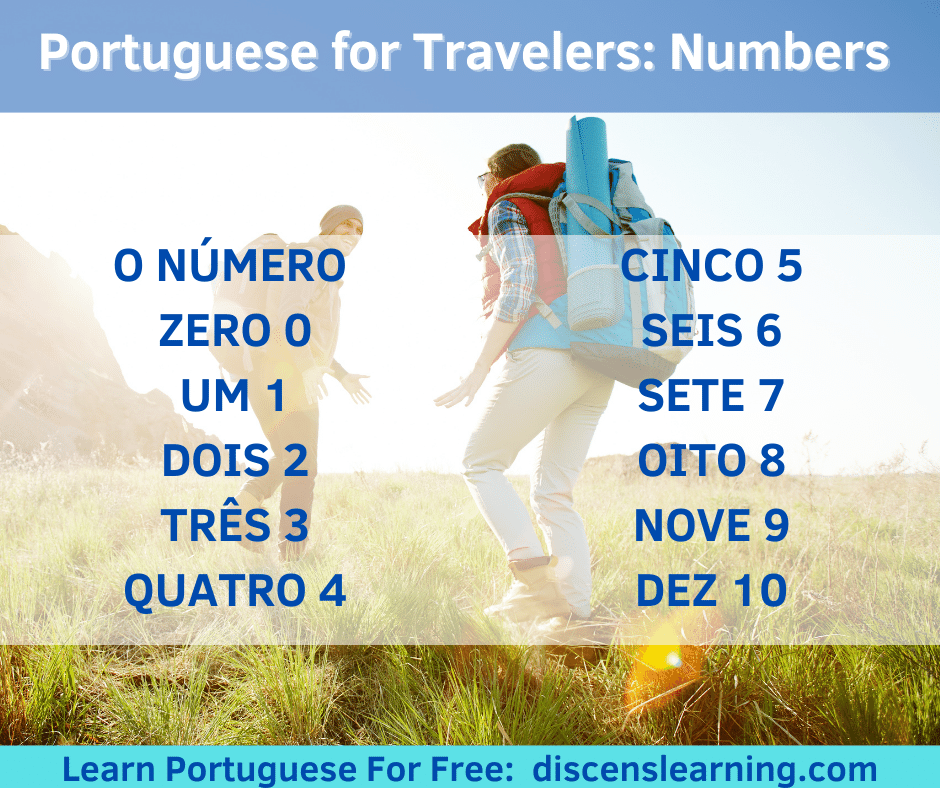
0 ZERO
1 UM
2 DOIS
3 TRĆS
4 QUATRO
5 CINCO
6 SEIS
7 SETE
8 OITO
9 NOVE
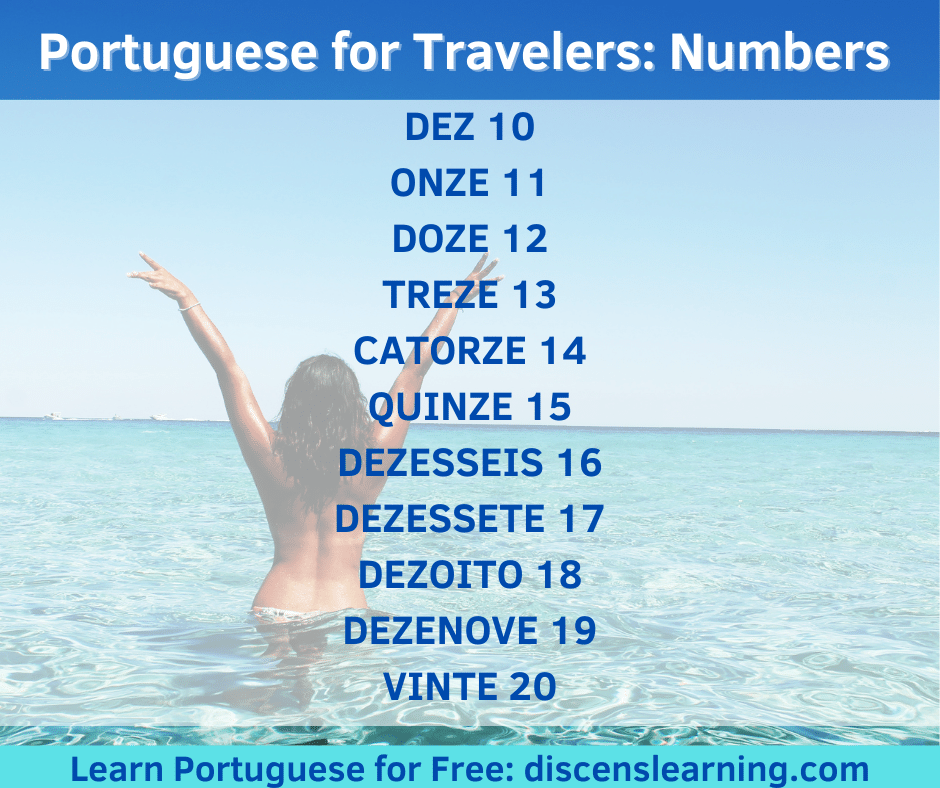
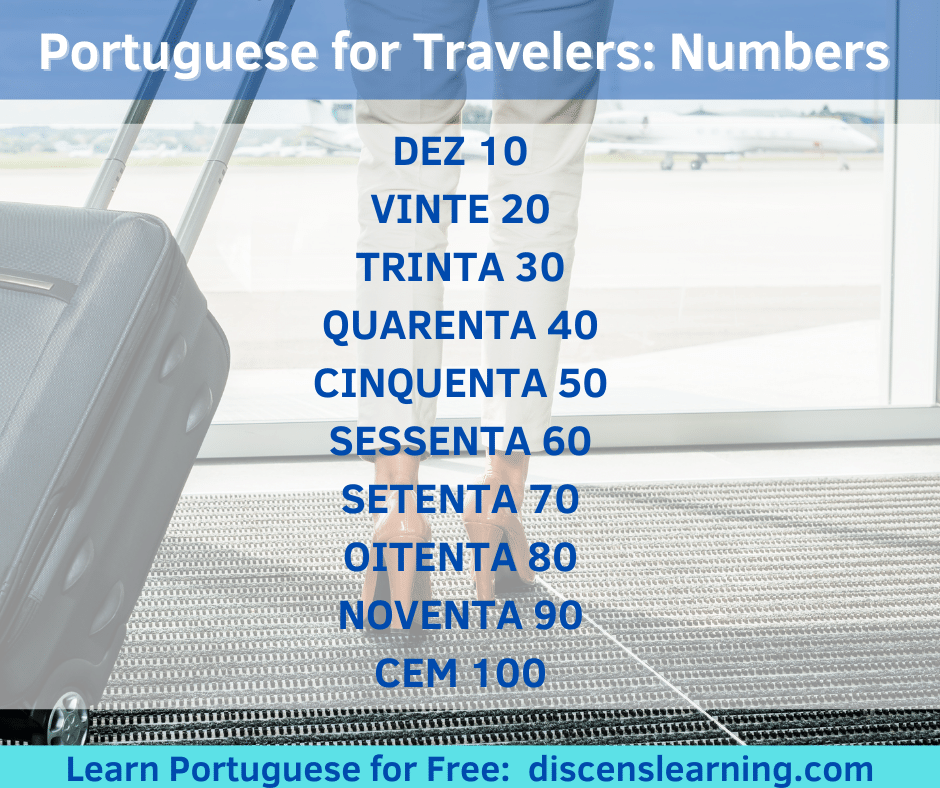
10 DEZ
11 ONZE
12 DOZE
13 TREZE
14 CATORZE
15 QUINZE
Starting with 16,Ā we read the Portuguese numbers from left to right:
10 + 6 = 16 = DEZESSEIS (āDEZ + E + SEISā, in one word)
(āEā means āANDā in Portuguese)
10 + 8 = 18 = DEZOITO (āDEZ + E + OITOā, in one word)
Starting from 20,Ā we separate the wordsĀ andĀ unite them with āEā:
20 + 1 = 21 = VINTE E UM
20 + 3 = 23 = VINTE E TRĆS
20 + 7 = 27 = VINTE E SETE
30 + 1 = 31 = TRINTA E UM
40 + 6 = 46 = QUARENTA E SEIS
80 + 9 = 89 = OITENTA E NOVE
How to indicate prices in Portuguese: useful tips for travelers
To name prices in Portuguese, you have many alternatives. I recommend using the shortest form for the most effective communication: 7,35⬠= SETE E TRINTA E CINCO.
QUANTO CUSTA? = āHow much does (something) cost?ā
Ā Em Portugal:
5,50ā¬: cinco (euros) e cinquenta (cĆŖntimos)
5,50ā¬: cinco e cinquenta
Ā No Brasil:
R$ 9,25: nove (reais) e vinte e cinco (centavos)
R$ 9,25: nove e vinte e cinco
How to greet in Portuguese: the simplest greetings, farewells, and politeness phrases for English-speaking travelers
You will learn the formulas to break the ice in Portuguese in the video starting on minute 03:42.
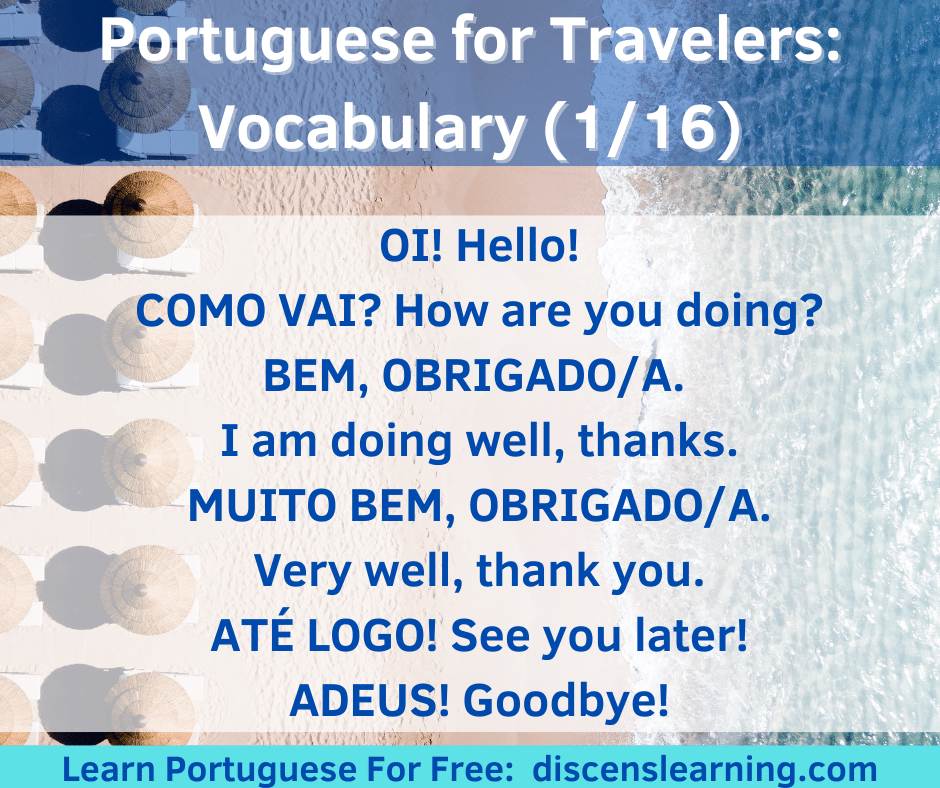
| Oi! | Hello! |
| Como vai? | How are you doing? |
| Bem, obrigado/a. | I am doing well, thanks. |
| Muito bem, obrigado/a. | Very well, thank you. |
| AtƩ logo! | See you later! |
| Adeus! | Goodbye! |
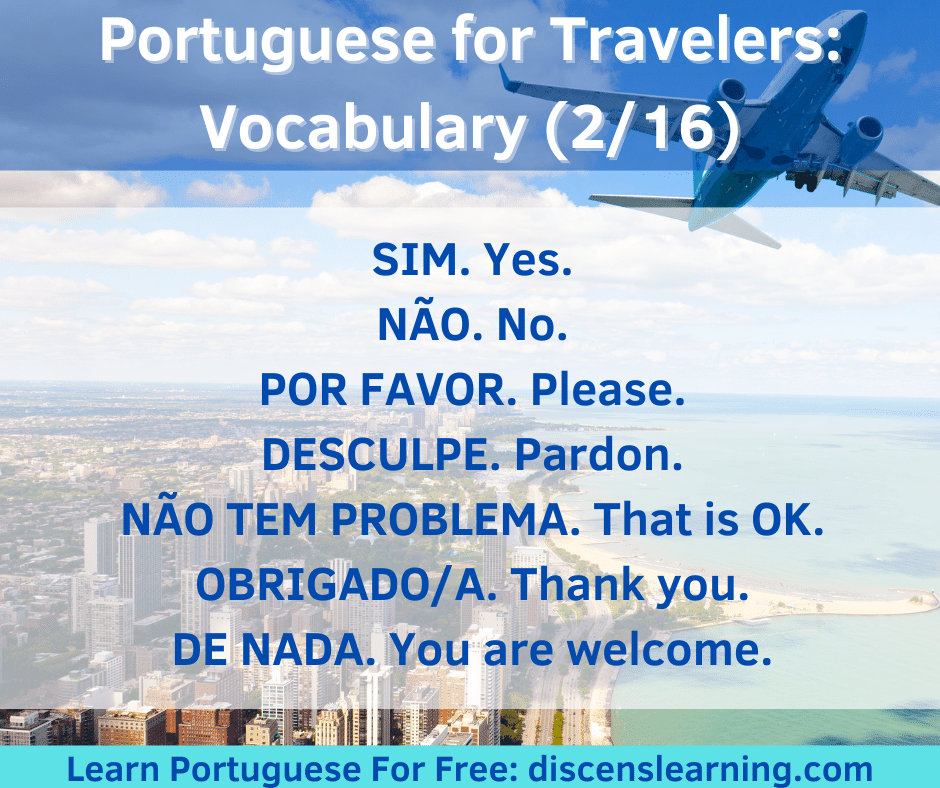
| Sim. | Yes. |
| NĆ£o. | No. |
| Por favor. | Please. |
| Desculpe. | Pardon. |
| NĆ£o tem problema. | That is OK. |
| Obrigado/a. | Thank you. |
| De nada. | You are welcome. |
| Oi! | Hello! |
| Como vai? | How are you doing? |
| Muito bem, obrigado/a. | Very well, thank you. |
| AtƩ logo! | See you later! |
| Adeus! | Goodbye! |
Ā āOIā in Brazil (Ā in Portugal is āOLĆā more common) is the most practical greeting in Portuguese because it can be said at any time and in many everyday situations, just like āhelloā in English.
Ā āADEUSā is the shortest way to say goodbye in Portuguese. With āADEUSā we do not know if we will see the person again. It can mean āfarewell without the possibility of reunionā, and as such, it does not have an exact translation in English.
In daily-life situations, you can say āADEUSā if you mean āsee you laterā. If you prefer something more colloquial instead, you can say āTCHAUā.
Ā To thank in English, we simply say āthank you (very much)ā. In Portuguese, it is different:
Ā A man thanks in Portuguese by saying ā(MUITO) OBRIGADOā.
Ā A woman thanks in Portuguese by saying ā(MUITO) OBRIGADAā.
āMUITOā means āmuchā. Therefore: āMUITO OBRIGADO/Aā = āthank you very muchā.
Ā In Brazil, to ask for something we use āPOR FAVORā and in Portugal, it is also customary to say āSE FAZ FAVORā.
Ā Tip: āOBRIGADO/Aā and āPOR FAVORā are short words that you can use freely in Portuguese because you will sound more polite. It is a minimal effort with great results.Ā
If you want to learn more expressions to greet, to say goodbye and to be polite in Portuguese, you have this video, with free downloadable material. It is the first lesson of theĀ complete Portuguese course with explanations in English. The course is online and includes webinars.
You have a video with the most useful phrases to greet, to say goodbye and to ask āhow are you?ā in Portuguese.Ā You have free material to practice, if you want.
How to give basic persona information in Portuguese when traveling abroad
How to introduce yourself in Portuguese
You will learn how to introduce yourself in Portuguese starting on minute of the video 06:34.| VocĆŖ ou o sr./a sra.? | Formal or informal? |
| Eu sou o/a ⦠. | I am ⦠āā. |
| Eu me chamo ⦠. | My name is ⦠. |
| O meu nome é ⦠. | My name is ⦠. |
| Como vocĆŖ se chama? | What is your name? |
| Como o sr./a sra. se chama? | What is your name? |
| Muito prazer! | Nice to meet you! |
| Igualmente! | You too! |
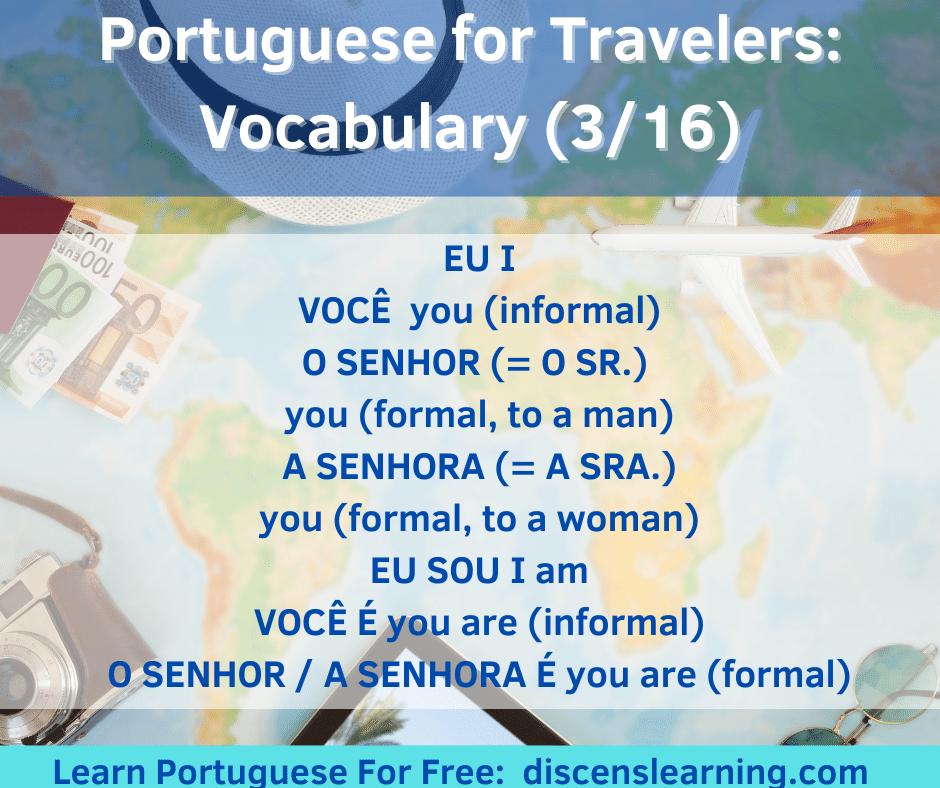
| eu | I |
| vocĆŖ | you (informal) |
| o senhor (= o sr.) | you (formal, to a man) |
| a senhora (= a sra.) | you (formal, to a woman) |
| eu sou | I am |
| vocĆŖ Ć© | you are (informal) |
| o senhor / a senhora Ć© | you are (formal) |
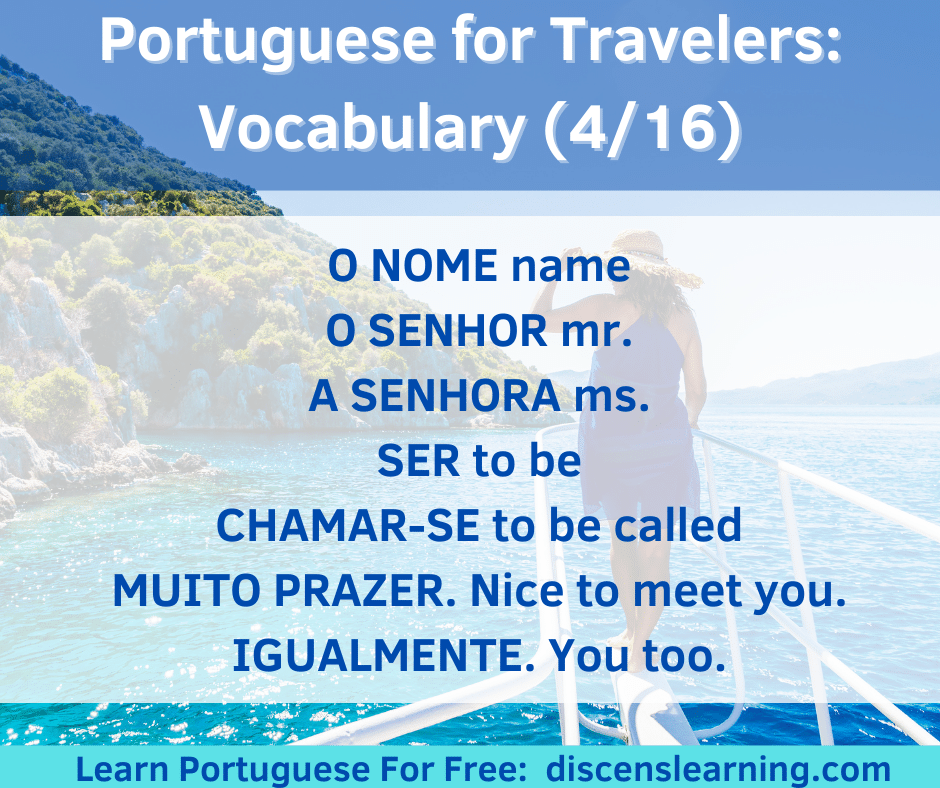
| o nome | name |
| o senhor | mr. |
| a senhora | ms. |
| ser | to be |
| chamar-se | to be called |
| Muito prazer. | Nice to meet you. |
| Igualmente. | You too. |
After the greetings, you will learn how you can introduce yourself. You can use the phrase āEU ME CHAMOā. In Portuguese, it is very common, although in English it does not have an absolute correspondence (it would be translated literally as āI call myselfā).
If you prefer, you can say āO MEU NOME Ćā.
Ā O MEU NOME Ć JĆLIO DA SILVA.
Ā EU SOU O JĆLIO DA SILVA.
More simply, āEU SOUā (or simply āSOUā), which you can combine with your name or with any other information that defines you: āEU SOU ESTUDANTEāĀ , for example. āEU ME CHAMOā and āO MEU NOME Ćā can only be combined with the personās name.
When we meet a new person, out of politeness we say āMUITO PRAZERā and the appropriate reaction is āIGUALMENTEā.
When to use the article with the personās name in Portuguese?
The masculine, definite article in Portuguese is āOā and the feminine, definite article is āAā.A man says āEU SOU Oā, and his name.
Ā EU SOU O JĆLIO.
Ā EU SOU A JĆLIA.
O JĆLIO Ć ESTUDANTE. = āJulio is a student.ā
A JĆLIA Ć ESTUDANTE. = āJĆŗlia is a student.ā
Ā You can combine āEU SOUā (or simply āSOUā) your name or any other information that defines you: āEU SOU ESTUDANTEāĀ , for example.āEU ME CHAMOā and āO MEU NOME Ćā can only be combined with the personās name. You do not put the article āOā or āAā before the name.
When to use āTUā AND āVOCĆā in Portuguese?
In Brazil, we use āVOCĆā with virtually anyone, male or female, young or old. It is the formula for informal treatment in Brazil. As Brazilian culture is quite informal, it is the formula we use automatically.In Brazil we also have āO SENHORā which is a formal form of address. Ā You use āO SENHORā when addressing a man and āA SENHORAā when addressing a woman. Both are very polite formulas. We only use them with aged persons or if the situation is very formal, for example, in a fancy restaurant.
- As a tourist in Brazil, you will predominantly use āVOCĆā. It is informal, but it is not disrespectful.
How to use the negatives in Portuguese
Saying ānoā in Portuguese is as simple as saying āNĆOā.
To say āyesā, in Portuguese you say āSIMā.
To turn a Portuguese affirmative sentence into a negative one,Ā we say āNĆOā right before the verb. If the affirmative sentence is āEU SOU ESTUDANTEā (āI am a studentā)Ā , the negation is āEU NĆO SOU ESTUDANTEāĀ
.
Ā Tip: If someone offers you something and you want to turn down the offer, in addition to āNĆOā, it is polite that you also say āOBRIGADO/Aā: āNĆO, OBRIGADO/Aā. And if you accept something, in addition to āSIMā you can say āPOR FAVORā: āSIM, POR FAVORā.
Talking about places in Portuguese: helpful phrases for travelers
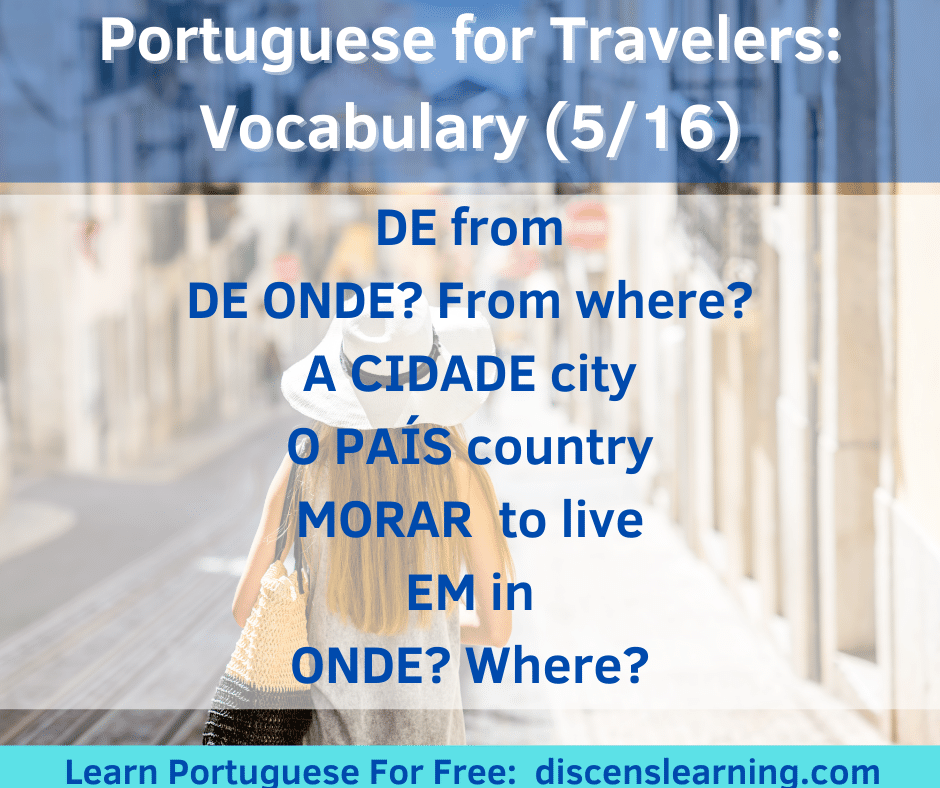
You will learn how to indicate the place you come from and your place of residence in Portuguese starting on minute Ā 13:26 of the video.| de | from |
| De onde? | From where? |
| a cidade | city |
| o paĆs | country |
| morar | to live |
| em | in |
| Onde? | Where? |
| Eu sou de ⦠(cidade, paĆs). | I am from⦠(city, country). |
| De onde vocĆŖ Ć©? | Where are you from? |
| De onde o sr./a sra. Ć©? | Where are you from? |
| Eu moro em ⦠(cidade, paĆs). | I live in⦠(city, country). |
| Onde vocĆŖ mora? | Where do you live? |
| Onde o sr./a sra. mora? | Where do you live? |
How to ask “Where are you from?” in Portuguese: talking about someoneās place of origin
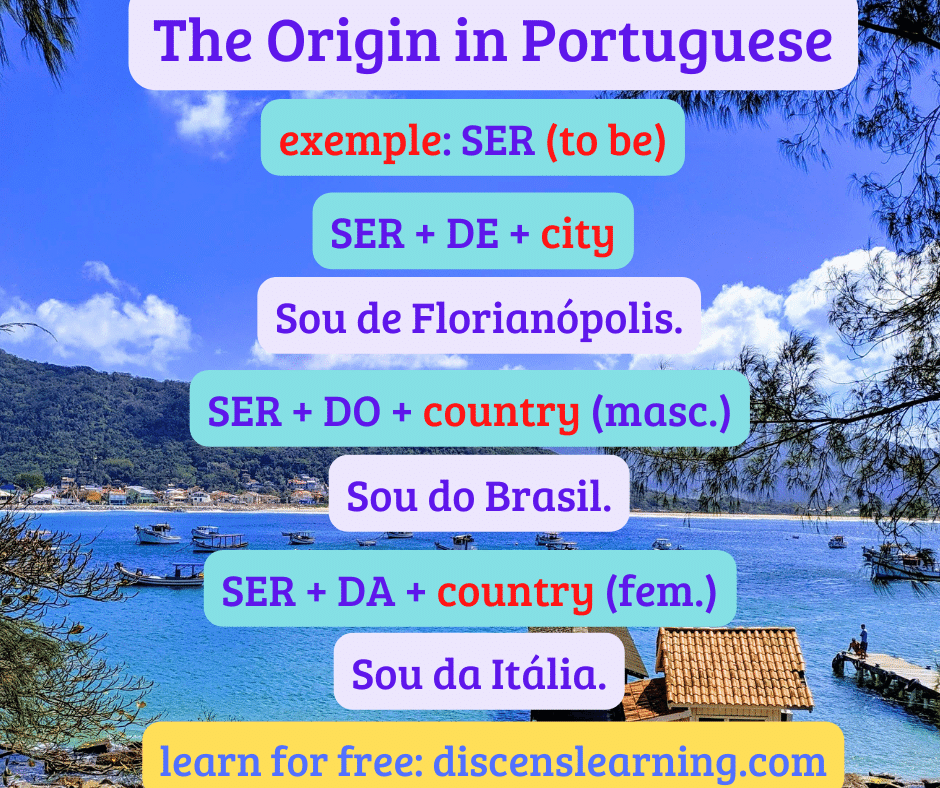
In Portuguese, to ask someone informally āWhere are you from?ā, you say āDE ONDE VOCĆ Ć?ā. If the situation is formal, the question is āDE ONDE O SENHOR/A SENHORA Ć?ā You answer with āEU SOU DEā¦ā and add the city:EU SOU DE (CIDADE), (PAĆS)
EU SOU DE CURITIBA, BRASIL. = āI am from Curutiba, Brazil.ā
To indicate origin, you will say:
āDOā + countryĀ (for countries with ending -O, -ĆO, and many others):
āDO BRASILā : āfrom Brazilā
āDAā + countryĀ (for countries with ending -A):
āDA FRANĆAā: āfrom Franceā
Ā
If you only want to indicate your country of origin, you can say:
Ā EU SOU DOS ESTADOS UNIDOS. = āI am from the U.S.ā
Ā EU SOU DO CANADĆ. = āI am from Canada.ā
Ā EU SOU DO REINO UNIDO = āI am from the United Kingdom.ā
Ā EU SOU DA IRLANDA. = āI am from Ireland.ā
Ā EU SOU DA ĆNDIA. = āI am from India.ā
Ā EU SOU DO BRASIL. = āI am from Brazil.ā
Ā EU SOU DE PORTUGAL. = āI am from Portugal.ā
How to ask āWhere do you live?ā in Portuguese: talking about someoneās place of residence
In Portuguese, to ask someone informally āWhere do you live?ā, you say āONDE VOCĆ MORA?ā.If the situation is formal, the question is āONDE O SENHOR/A SENHORA MORA?ā
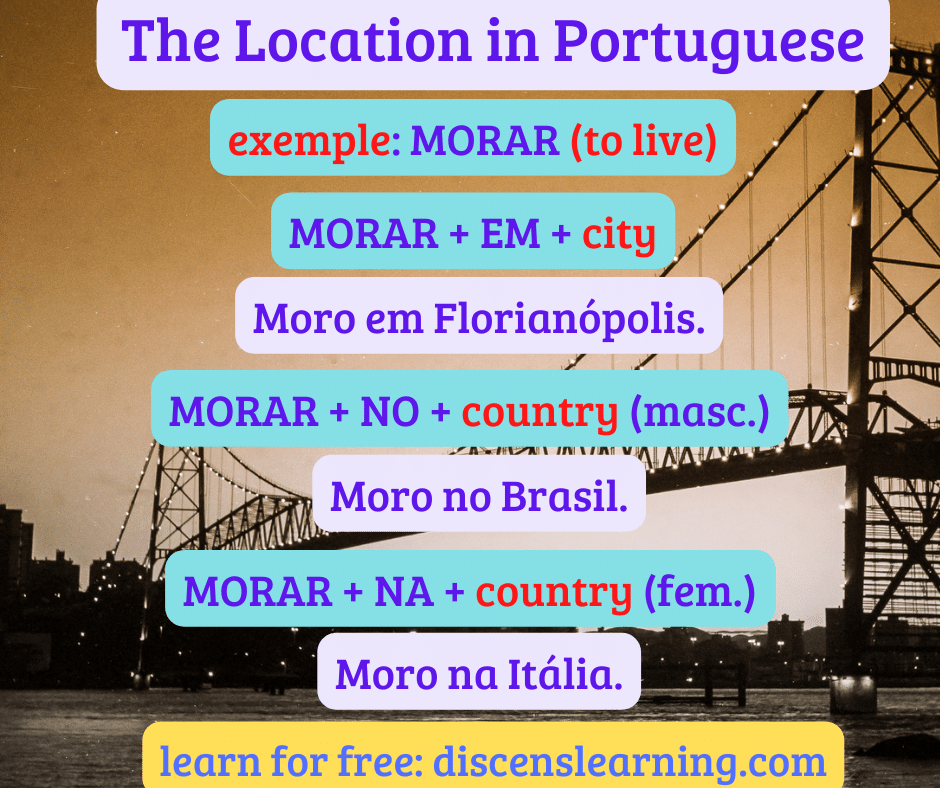
You answer āEU MORO EMā and add the place where you live.
EU MORO EM (CIDADE), (PAĆS)
EU MORO EM CURITIBA, BRASIL. = āI live in Curitiba, Brazil.ā
To indicate the country where you live, you will say:
āNOā + countryĀ (for countries with ending -O, -ĆO, and many others):
Ā āNO BRASILā : āin Brazilā
āNAā + countryĀ (for countries with ending -A):
Ā āNA FRANĆAā: āin Franceā
Ā EU MORO NOS ESTADOS UNIDOS. = āI live in the U.S.ā
Ā EU MORO NO CANADĆ. = āI live in Canada.ā
Ā EU MORO NO REINO UNIDO = āI live in the United Kingdom.ā
Ā EU MORO NA IRLANDA. = āI live in Ireland.ā
Ā EU MORO NA ĆNDIA. = āI live in India.ā
Ā EU MORO NO BRASIL. = āI live in Brazil.ā
Ā EU MORO EM PORTUGAL. = āI live in Portugal.ā
āMORARā in Portuguese means āto resideāĀ Ā and āVIVERā means āto live, to be aliveāĀ
.
You have a short video where you will learn more phrases to indicate your place of origin and residence in Portuguese.Ā It is part of a guide with short videos and quizĀ to learn the most essential Portuguese that you will surely find useful for your next vacation.
How to overcome communication difficulties in Portuguese on a trip
You will learn the phrases in Portuguese to solve communication problems starting on minute 17:40 of the video.| falar | to speak |
| eu falo | I speak |
| vocĆŖ fala | you speak (informal) |
| o senhor / a senhoa fala | you speak (formal) |
| portuguĆŖs | Portuguese |
| espanhol | Spanish |
| inglĆŖs | English |
| alemão | German |
| NĆ£o compreendo. | I do not understand. |
| NĆ£o entendo. | I do not understand. |
| O que significa ⦠? | What does ⦠mean? |
| Mais devagar, por favor. | Slowly, please. |
| VocĆŖ fala inglĆŖs? | Do you speak English? |
| O sr./a sra. fala inglĆŖs? | Do you speak English? |
| Eu não falo português. | I do not speak Portuguese. |
| Eu falo um pouquinho de portuguĆŖs. | I speak a little Portuguese. |
How to say āI do not understandā and āWhat does it mean?ā in Portuguese
You have two ways of explaining that you do not understand: āNĆO COMPREENDOā and āNĆO ENTENDOā. You can use the one you like the most.Tip: To be more polite, you can add āDESCULPEā to āNĆO COMPREENDOā. To apologize, you can also say āSINTO MUITOā.
Ā SINTO MUITO, NĆO ENTENDO.
Ā NĆO COMPREENDO NADA.
Ā NĆO ENTENDO NADA.
How to say āI do not speak Portugueseā
You can indicate the languages āāyou speak in Portuguese by saying āEU FALOā¦ā. For the negative, you say āEU NĆO FALOā¦āTravel phrases in Portuguese: basics that every tourist should know
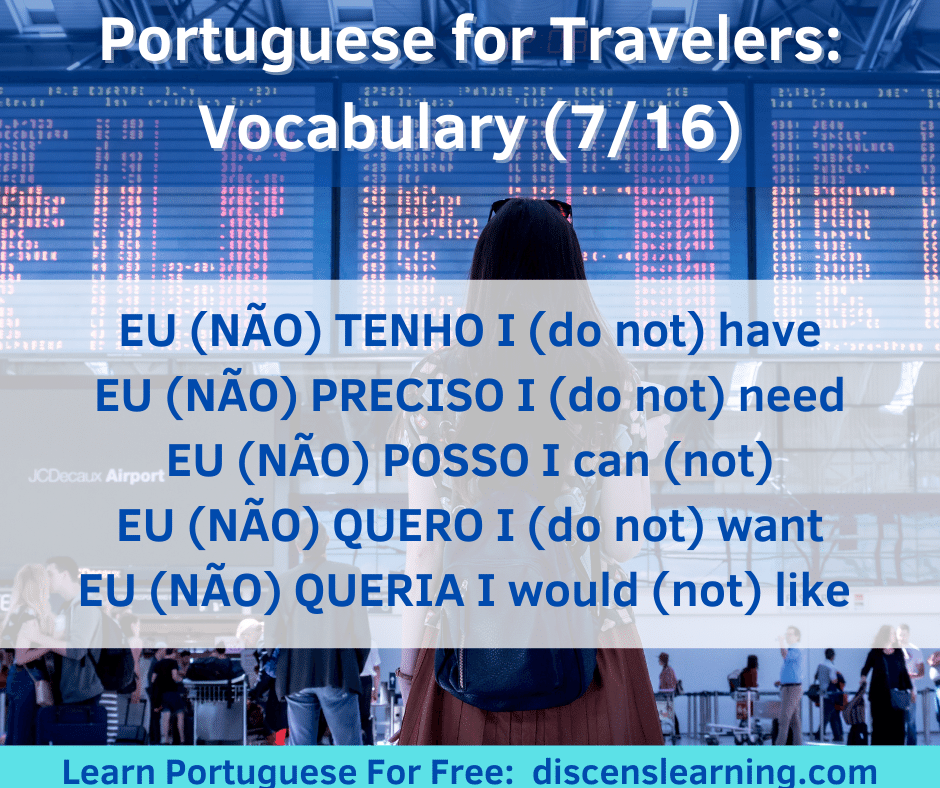
Important verbs in Portuguese: āTERā, āPRECISARā, āPODERā, āQUERERā
You can communicate a lot using these words!| eu (não) tenho | I (do not) have |
| eu (não) preciso | I (do not) need |
| eu (não) posso | I can (not) |
| eu (não) quero | I (do not) want |
| eu (não) queria | I would (not) like |
What is the difference between āEU QUEROā and āEU QUERIAā in Portuguese?
āEU QUEROā isĀ directĀ and useful to talk about what you want in general, i.e., your goals and desires.
You can combine āEU QUEROā:
- with infinitive verbs: EU QUERO FALAR PORTUGUĆS.Ā
Ā = āI want to speak Portuguese.ā
- with nouns: EU QUERO UM CAFĆ.Ā
Ā = āI want a coffee.ā
If you say āEU QUERO UM CAFĆā in a cafĆ©, the waiter will give you the coffee, for sure. But it is not the friendliest way to order in Portuguese.
Ā āEU QUERIAā is more polite than āEU QUEROā. Ā It is used to express wishes, but when we want something from someone.
You can combine āEU QUERIAā with verbs in the infinitive or with nouns.
- EU QUERIA TROCAR DINHEIRO. = āI would like to exchange money.ā
Ā EU QUERIA UM CAFĆ, POR FAVOR. = āI would like a coffee, please.ā
Ā EU QUERIA A CONTA, POR FAVOR. = āI would like the check, please.ā
Simply saying āA CONTA, POR FAVORā is not rude, but it is not very polite either.
But do not worry: if you are traveling as a tourist, local people will appreciate that you know a little Portuguese. Speaking the language of the country is a nice gesture of courtesy.Ā
Ā Tip: āEU QUERIAā can be used to order in the restaurant or cafĆ©, to do any kind of shopping and even to ask someone for a favor.
Ā Tip: Are you a romantic? Do you want to say āI love youā in Portuguese? So do it the right way, and do not mix Spanish with Portuguese. In Spanish, you say āte quieroā. In Portuguese you say āTE AMOā . Saying to someone āTE QUEROā is possible, but it means literally āI want youā. So: to declare your love, just say āTE AMO, MEU AMORā (āI love you, my loveā).
Ā
Do you want to learn some useful phrases to pay a compliment and to flirt with someone in Portuguese? You will find them in this video (starting from minute 07:34).
How to indicate physical needs and other basics in Portuguese
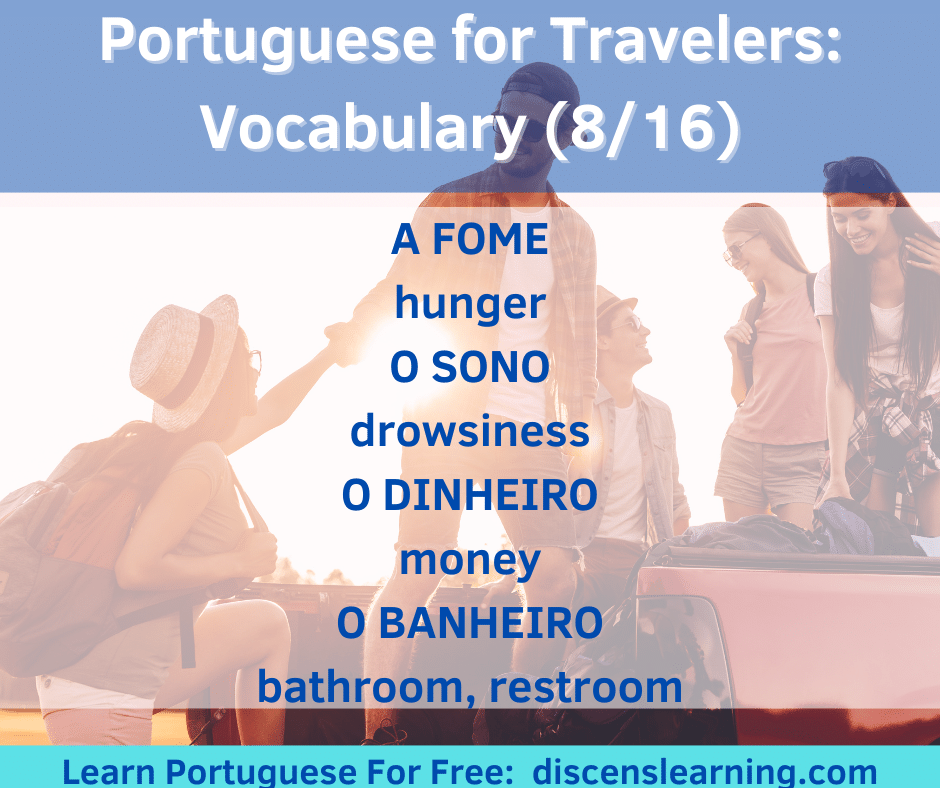
You will learn how to talk about your basic needs and you will know phrases for emergencies in Portuguese starting on minute 19:40 of the video.| a fome | hunger |
| o sono | drowsiness |
| o dinheiro | money |
| o banheiro | bathroom, restroom |
| Estou com fome. | I am hungry. |
| Estou com sono. | I am sleepy. |
| NĆ£o tenho dinheiro. | I have no money. |
| Onde fica o banheiro? | Where is the restroom? |
How to ask for help in Portuguese and how to communicate in an emergencyĀ during your trip
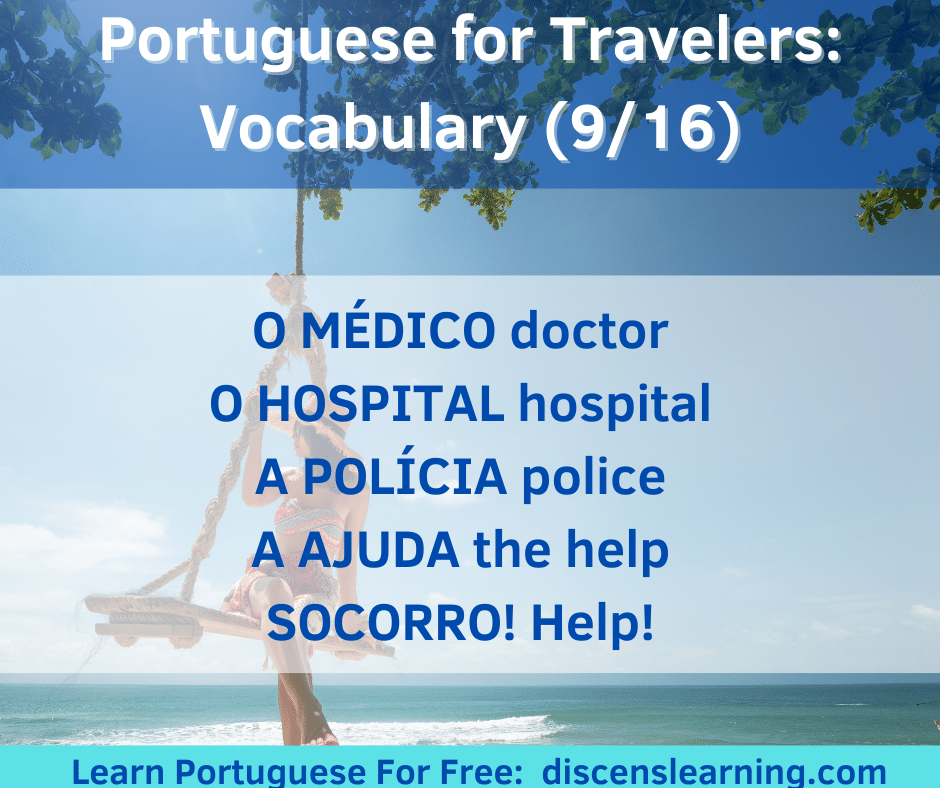
Hopefully, everything runs smoothlyĀ| o mĆ©dico | doctor |
| o hospital | hospital |
| a polĆcia | police |
| a ajuda | the help |
| Socorro! | Help! |
| precisar | to need |
| Preciso de um mƩdico. | I need a doctor. |
| Preciso ir para o hospital. | I need to go to the hospital. |
| Preciso de ajuda! | I need help! |
| Ajuda! Socorro! | Help! Help! |
| PolĆcia! Fui roubado/a! | Police! I was robbed! |
How to talk about money and make purchases: Portuguese phrases for travelers
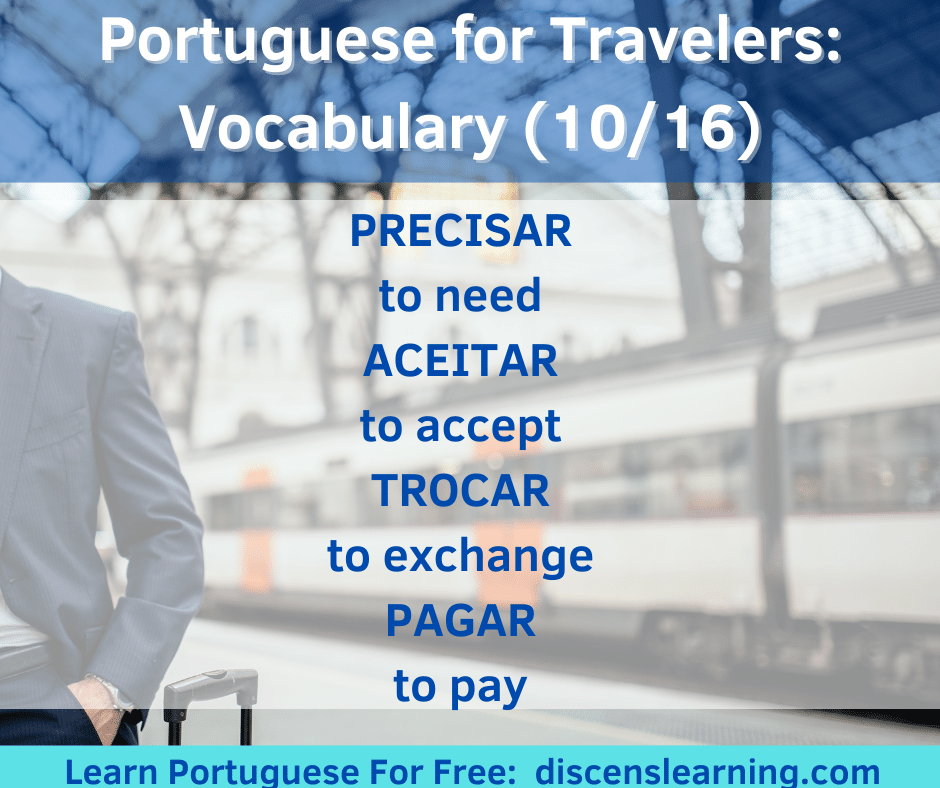
You will learn the useful phrases to talk about money and to make purchases on your next trip starting on minute 22:06 of the video.| aceitar | to accept |
| trocar | to exchange |
| pagar | to pay |
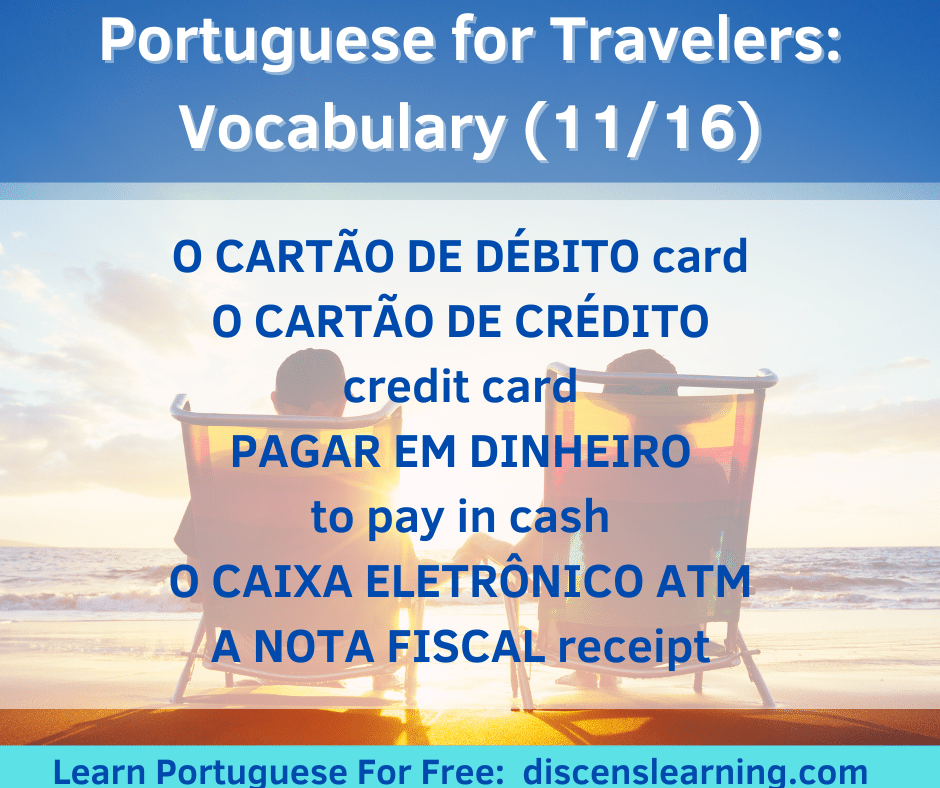
| o cartão de débito | card |
| o cartão de crédito | credit card |
| pagar em dinheiro | to pay in cash |
| o caixa automƔtico | ATM |
| a nota fiscal | receipt |
| Onde posso trocar dinheiro? | Where can I exchange money? |
| Aceitam cartão de crédito? | Do you accept credit card? |
| Aceitam dólares? | Do you accept dollars? |
| Onde tem um caixa eletrƓnico? | Where is there an ATM? |
| Posso pagar em dinheiro? | Can I pay in cash? |
| Posso pagar com cartão? | Can I pay with card? |
| Aqui estĆ”. | Here you go. |
| Isto Ć© tudo. | This is all. |
| (NĆ£o) Preciso da nota fiscal. | IĀ (do not) need the receipt. |
You should learn some phrases to exchange money and to pay in stores or restaurants during your holidays.
In Brazil we say āCAIXA ELETRĆNICOā and in Portugal, āMULTIBANCOā.
Ā Tip: two phrases that the store clerk will always ask in Brazil when you pay are:
āCRĆDITO OU DĆBITO?ā (ācredit or debit?ā): in Brazil, many cards for making payments are credit and debit cards at the same time. If you use a Brazilian card, you must choose which payment you want to make. This video uses the question āCRĆDITO OU DĆBITO?ā for a humorous sketch:
Communication in the hotel: Portuguese phrases for travelers
You will learn the phrases in Portuguese to use in the hotel and restaurant starting on minute 25:05 of the video.
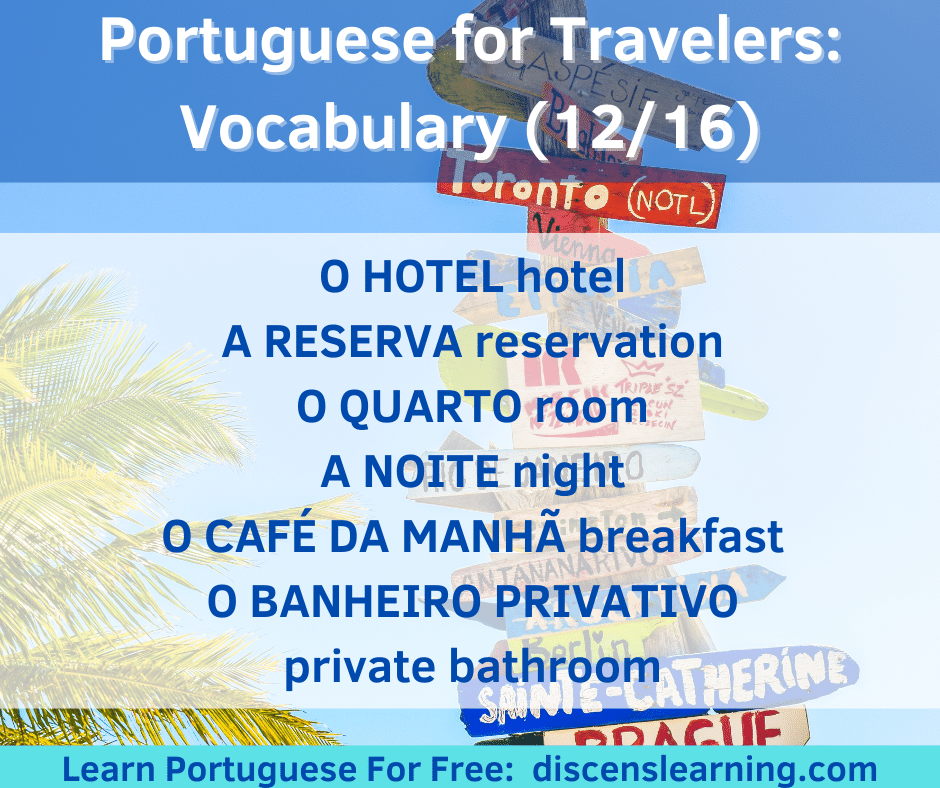
| o hotel | hotel |
| a reserva | reservation |
| o quarto | room |
| a noite | night |
| o café da manhã | breakfast |
| o banheiro privativo | private bathroom |
| (NĆ£o) Tenho uma reserva. | I (do not) have a reservation. |
| Preciso de um quarto duplo por trĆŖs noites. | I need a double room for three nights. |
| (Não) Quero café da manhã. | I (do not) want breakfast. |
| (NĆ£o) Quero um banheiro privativo. | I (do not) want a private bathroom. |
In the hotel, you must inform your name and where you are from. These are useful phrases that you have already learned in this Portuguese guide for travelers.
You can adapt the basic phrases to your needs.
PRECISO DE UM QUARTO DUPLO POR TRĆS NOITES.
= āI need a double room for three nights.ā
For example, at the hotel, you can say āQUERO/QUERIA UM QUARTO INDIVIDUAL PARA CINCO NOITES ā and they will give you a single room for five nights.
Ā In Brazil we say āCAFĆ DA MANHĆā and in Portugal, āPEQUENO ALMOĆOā. āALMOĆOā is lunch and āPEQUENO ALMOĆOā is a direct translation from French āpetit dĆ©junerā.
In this video (starting on minute) you will learn the most useful questions and answers to make purchases and order in the cafĆ© in Portuguese.Ā You have material to download for free.Ā
Communication in the restaurant: Portuguese phrases for your vacation
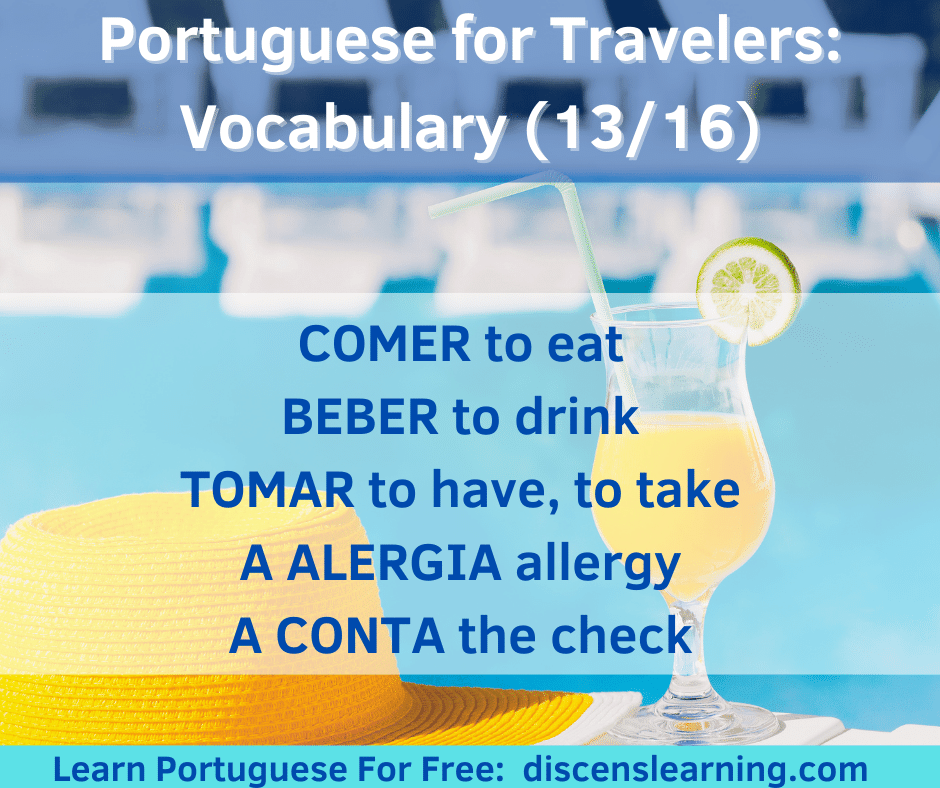
| comer | to eat |
| beber | to drink |
| tomar | to have, to take |
| a alergia | allergy |
| a conta | the check |
| Para comer, eu queria ⦠. | To eat, I would like ⦠. |
| Para beber, eu queria ⦠. | To drink, I would like ⦠. |
| NĆ£o posso tomar ⦠. | I canāt have ⦠. |
| Tenho alergia a ⦠. | I am allergic to ⦠. |
| A conta, por favor. | The check, please. |
Tip: You can ask for the restaurantās menu (āO CARDĆPIOā, in Portugal āA EMENTAā) in English (āTEM O CARDĆPIO EM INGLĆS?ā) and use the phrases you have seen to order.
PARA BEBER, YO QUERĆA UNA CERVEJA. = āTo drink, I would like a beer.ā
You can simply say the name of what you want to order and add āPOR FAVORā: āāUMA CERVEJA, POR FAVORā.How to call the waiter in a restaurant or bar
To get the waiterās (or the waitressā) attention in Portuguese, you can say:Ā DESCULPE!
Ā COM LICENĆA!
GARĆOM! (in Brazil)
Communication in the city and in the transport: Portuguese phrases for travelers
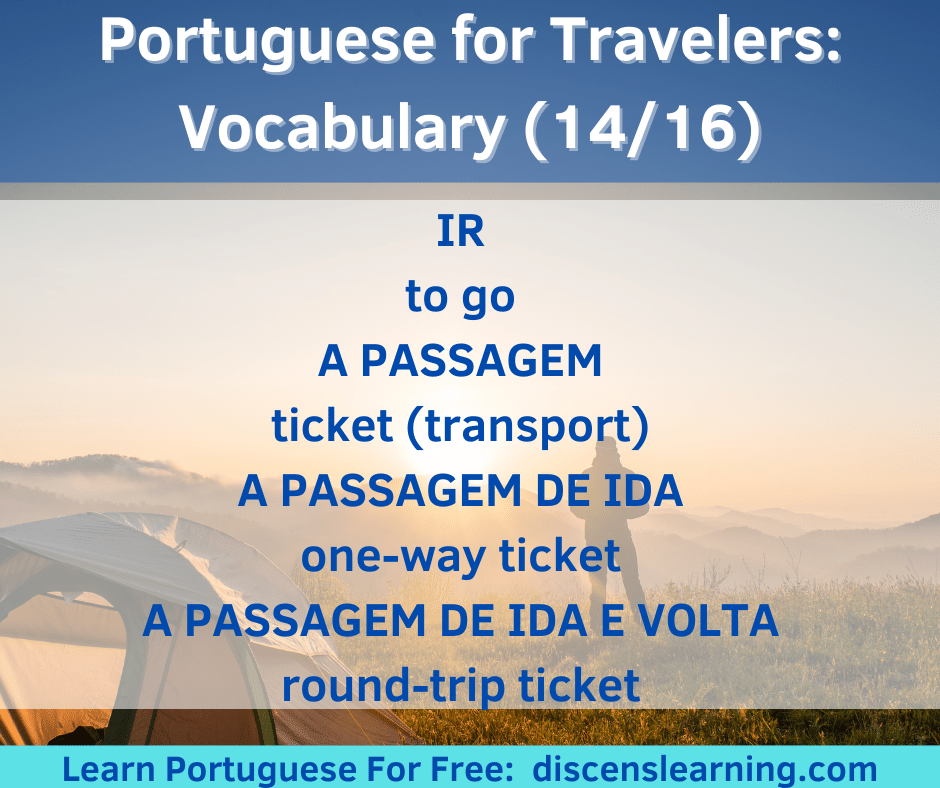
You will learn the practical phrases in Portuguese to ask for directions and to ask for information in the public transport on your next trip from the minute 27:57 of the video.| ir | to go |
| a passagem | ticket (transport) |
| a passagem de ida | one-way ticket |
| a passagem de ida e volta | round-trip ticket |
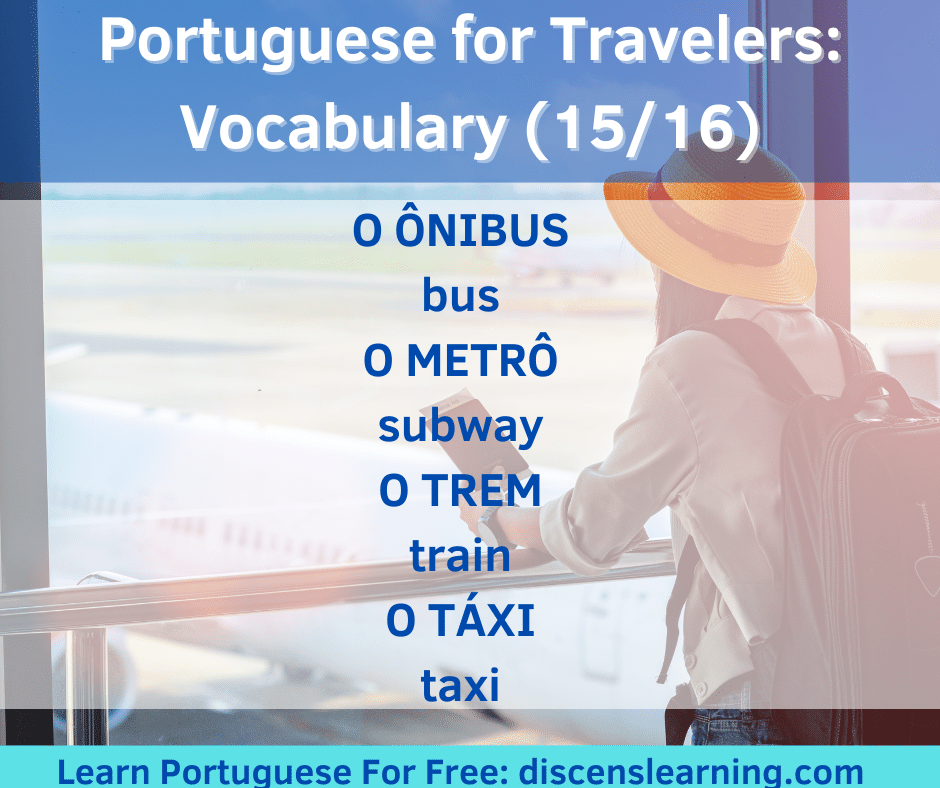
| o Ɠnibus | bus |
| o metrƓ | subway |
| o trem | train |
| o tƔxi | taxi |
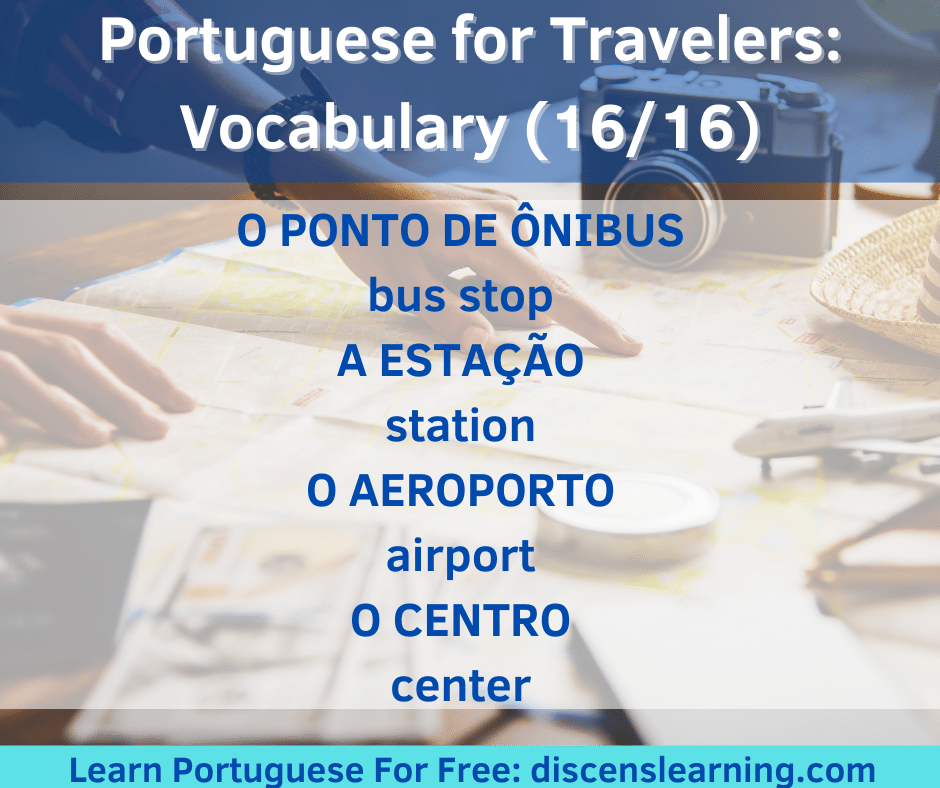
| o ponto de Ɠnibus | bus stop |
| a estação | station |
| o aeroporto | airport |
| o centro | center |
| Quanto custa uma passagem de ida para ⦠? | How much does a one-way ticket to ⦠cost? |
| Eu queria uma passagem de ida e volta para ⦠. | I would like a round-trip ticket to ⦠. |
| Onde tem um ponto de Ɠnibus? | Where is there a bus stop? |
| Onde fica a estação? | Where is the station? |
| Pode me levar para o aeroporto? | Can you take me to the airport? |
| Como posso ir para o centro? | How can I go to the city center? |
| Este Ɠnibus vai para o aeroporto? | Does this bus go to the airport? |
| Que trem vai para o centro? | Which train goes to the city center? |
Currently, it is possible to obtain all the information about transport and the city using only smartphone apps.
Ā In Brazil we say ā(TELEFONE) CELULARā and in Portugal, āTELEMĆVELā.
But if you know some simple phrases in Portuguese to ask for information for your holidays, you will see that you will create the opportunity to chat with the locals.
The person may answer your question in long sentences that you do not know, but no problem! It is customary to gesticulate a lot when we give directions on the street. For this reason, you will understand a good part of what the native says thanks toĀ non-verbal communication.
You can adapt these phrases to your needs. Instead of saying
āCOMO POSSO IR PARA O CENTRO?ā
you can say
āCOMO POSSO IR PARA A ESTAĆĆO?ā
We use āPARA Oā because āCENTROā is a masculine noun.
We use āPARA Aā because āESTAĆĆOā is a feminine noun.
In Brazil we generally say āĆNIBUSā and in Portugal, āAUTOCARROā.
Ā In Brazil we say āTREMā and in Portugal, āCOMBOIOā.
Brazilian Portuguese or European Portuguese? What is the difference? What Portuguese should I learn for my vacation?
Obviously, the Portuguese spoken in different regions varies a little. Itās normal because it is the mother tongue of 230-250 million people around the world. The difference between the language in different regions is more noticeable in oral Portuguese than in written Portuguese.Vocabulary can be a little different, especially when talking about everyday objects, as you have seen in this Portuguese language guide.Ā But normally the Brazilian and European vocabulary are not so different.
Everything is a matter of point of view, but Brazilian Portuguese is known to be easier for a foreigner to learn. In general, we Brazilians speak more slowly and pronounce all the vowels.
Brazilian Portuguese, for many, sounds āsofterā than the Portuguese spoken in Portugal. Even the Portuguese writer EƧa de Queirós said in the 19th century that in Brazil people speak āPortuguese with sugarā (āPORTUGUĆS COM AĆĆCARā).
In Portugal, for example, at the end of a word, the letter -E in the combinations -DE or -TE is inaudible. In Brazil in general, we will pronounce respectively dŹi and ʧi, sounds that are similar to ājā in ājeansā. You can see this in the words āDEā (āfromā) or āVINTEā (20).
Furthermore, in Brazil, we use a simplified grammar in some respects. For example, the pronoun āTUā, as we saw above, which in Brazil is not used systematically.
Is it useful for me to speak some ābroken Portugueseā during a trip?
Of course! Although English is spoken in many tourist areas in Portugal and Brazil, there are many advantages in mastering simple but practical Portuguese phrases. Ā And you do not have to worry about learning specifically āBrazilian Portugueseā or āEuropean Portugueseā for your trip, as we have seen.Portuguese is official in 8 countries and ā of course ā it is a little different in these regions. Accents, slang, and some words for everyday objects may be different depending on where you are.Ā But no matter where you go, the Portuguese you learn in this guide,Ā on the blog, and in the courses on this site, even though it is Brazilian Portuguese,Ā will allow natives to understand your Portuguese. With a simple vocabulary like the one you can learn here, you can make yourself understood without difficulty.
In general, Portuguese speakers value positively that a foreigner tries to speak their language. They are especiallyĀ friendly and patientĀ if they see a foreigner trying to make him/herself understood.
In other words, by having a basic grasp of Portuguese, you will get to know more people, and your traveling experience will be more colorful and memorable.
Conclusion
Do you want to keep on learning Brazilian Portuguese online & for free?
Your first contact with the Portuguese language.
How to Speak Portuguese: Guide for English-Speaking Beginners
A series of 1-minute videos to learn the most basic Portuguese with transcriptions, audios, and quizzes.
Learn Useful Portuguese Phrases with Free Videos & Materials
The most common greetings, farewells and politeness phrases in Portuguese.
The 81 TOP questions and answers in Portuguese.
https://discenslearning.beyondedge.website/questions-and-answers-in-portugueseādownload-free-pdf-and-mp3
The most thorough guide on greetings and goodbyes in Brazilian Portuguese.
https://discenslearning.beyondedge.website/downloadable-pdfāmp3ā89-portuguese-conversation-starters
Vocabulary: the most relevant verbs in Portuguese for English speakers.
Free Video Guide: Portuguese Verbs for English Speakers
Vocabulary: the most relevant nouns in Portuguese for English speakers.
https://discenslearning.beyondedge.website/basic-noun-vocabulary-in-portuguese-wih-free-video-pdfāmp3
šIn this playlist, you will find videos to learn Portuguese with explanations in Portuguese (with Portuguese & English subtitles):
šYou have FREE videos to learn Brazilian Portuguese with downloadable material for English-speaking beginners on the blog ā no registration needed.
šUseful Portuguese videos on the YouTube channel ā Subscribe!
šLearn conversational Brazilian Portuguese on Facebook!
šLearn Brazilian Portuguese basics on Pinterest!
https://www.pinterest.es/discenslearning/portuguese-for-english-speakers-a1/
About the author: I am Alicia, your Portuguese teacher š. I was born in SĆ£o Paulo, Brazil, and I was raised trilingual, since my mother is German and my father, Spaniard. I did my undergraduate and Ph.D. studies in Madrid and Berlin. After completing my Masters in Didactics in 2010, I applied my knowledge to foreign language teaching. I worked at the Popular University in Berlin with group classes until 2018. Since then, I have specialized in online teaching and the creation of digital learning content.
Images obtained via CanvaĀ®.
©2021 Alicia Montero Schiemann
All rights reserved.
Discens Language LearningĀ®